
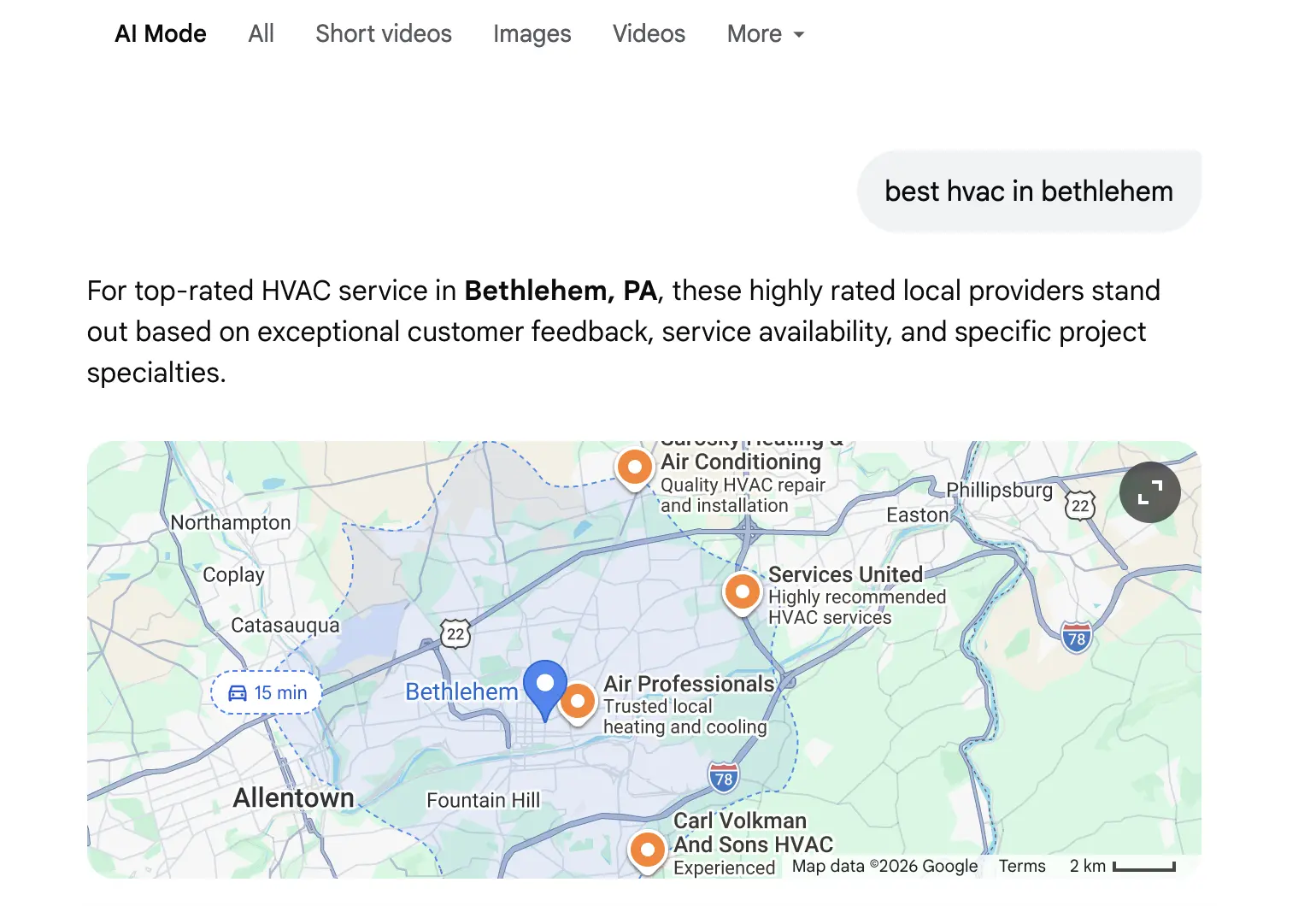
A homeowner in Bethlehem needs a new roof. Two years ago she typed “roofers near me” into Google, scanned the map pack, and called two of the three businesses she saw. Today she asks ChatGPT which roofer to call, gets three names and a paragraph explaining why, and calls one. She never sees a search results page. She never sees your ad. She sees a recommendation.
If your business is not one of the three names, you did not lose a ranking. You were never in the conversation.
Answer engine optimization is the work of making sure you are. Here is what it actually means, what it does not mean, and how to tell the difference between an agency doing the work and an agency selling the acronym.
What answer engine optimization actually is
Answer engine optimization (AEO) is the practice of structuring your business’s online information so AI systems can extract it, trust it, and repeat it as a direct answer. Where traditional SEO competes for a position on a page of links, AEO competes to be the source a machine quotes when it answers a question on your behalf.
The distinction matters because the unit of success changed. In classic search, success is a click. In an answer engine, success is a citation — your business named, your page linked, your claim used as the basis for the answer. Very often nobody clicks anything at all, and the mention itself is the entire return.
People keep asking me how they rank number one in ChatGPT. There is no number one. There’s the answer, and there’s everything that didn’t make it into the answer. That’s a much harder room to get into, and it’s a much better room to be in once you’re there.
Bradford Blecker, Founder, Bradford Strategies
What counts as an “answer engine”
An answer engine is any system that responds to a question with a synthesized answer rather than a list of links. In practice, for a service business in 2026, that means five surfaces:
- Google AI Overviews — the AI-generated block above the traditional results, grounded in Google’s own index.
- Google AI Mode — the fully conversational search experience, which breaks a question into multiple sub-queries before answering.
- ChatGPT search — which retrieves live results through Bing’s index rather than Google’s.
- Perplexity — a dedicated answer engine that cites heavily and links generously.
- Gemini and Claude — general assistants that increasingly pull live sources when asked about real businesses.
These are not one audience. They run on different indexes and reward different things, which is the single most under-appreciated fact in this entire category. Optimizing for Google’s AI Overviews and optimizing for ChatGPT are overlapping but genuinely separate jobs. We break that down in detail in how to get cited by ChatGPT, Gemini, and Google AI Overviews.
How AEO differs from SEO — and where they overlap
The honest answer is that AEO is not a replacement for SEO. It is a layer built on top of it, and it fails without the layer underneath.
| Traditional SEO | Answer engine optimization | |
|---|---|---|
| Goal | Rank a page | Become a cited source |
| Unit of success | A click | A mention, with or without a click |
| Optimizes for | A ranking algorithm | A retrieval system plus a language model |
| Content shape | Comprehensive pages | Extractable claims inside comprehensive pages |
| Off-site lever | Backlinks | Brand mentions and third-party validation |
| Measurement | Rank tracking, organic traffic | Citation share, prompt-level visibility |
Notice the last row of the “optimizes for” line. Every answer engine has two stages: a retrieval stage that finds candidate sources, and a generation stage that decides which of them to actually use. Classic SEO is very good at winning stage one. It does almost nothing for stage two. AEO is the work of winning both.
The data behind it
Two findings from independent research explain why this became a separate discipline rather than a footnote in an SEO checklist.
Ranking well is a real advantage that is getting weaker. Ahrefs analyzed 1.9 million citations across a million AI Overviews in July 2025 and found that 76% of cited pages also ranked in Google’s top 10. When the same analysis was re-run in early 2026 across a much larger sample, that overlap had fallen sharply — reported at 38%. Read directionally rather than as a precise figure, the trend is unmistakable: AI Overviews are increasingly citing pages that do not rank on page one. A top-10 ranking used to be close to a guarantee of consideration. It is now an advantage, not a ticket.
The engines barely agree with each other. ChatGPT, which retrieves through Bing, has been measured at roughly 6.5% overlap with Google’s top 10 results. Perplexity, by contrast, sits around 82% overlap. Those two systems, asked the same question about your industry, are drawing from almost entirely different pools of sources.
Put those together and the strategic conclusion is uncomfortable but simple: a business can rank respectably in Google and be functionally invisible in the AI surfaces where a growing share of its buyers are now asking questions.
What AEO work actually looks like
Stripped of the vocabulary, real AEO comes down to five things. None of them are tricks, and all of them take months rather than weeks.
1. Answering the question directly, in the first two sentences
A language model extracts what it can lift cleanly. A page that spends four paragraphs warming up before defining the term it is supposedly about gives it nothing to lift. Every page that targets a question should answer that question immediately, in one sentence a machine could quote without editing, and then earn the reader’s time afterward.
2. Publishing things nobody else has
The Princeton-led GEO benchmark tested content edits across 10,000 queries and found the largest visibility gains came from adding direct quotations, original statistics, and inline citations to sources. That is a research finding with an obvious business translation: your own numbers are your best asset. Average job value in your market. How long a repair actually takes in February versus July. What percentage of your calls come from a specific neighborhood. Nobody else can publish those, which is precisely why they get quoted.
3. Structure that survives extraction
Tables, short definitional paragraphs, genuine question-shaped headings, and clean lists get pulled at measurably higher rates than flowing prose. This is not a reason to write badly. It is a reason to make sure the skeleton of a good page is visible from the outside.
4. Being described consistently everywhere else
This is the part most businesses skip, and it may be the most important. Ahrefs found that brand mention frequency correlates with AI Overview presence at roughly three times the strength of backlinks. Separately, analysis of branded queries found that reviews and third-party validation account for the large majority of citations, while the brand’s own pages account for a tiny fraction.
An answer engine asked “who’s a good roofer in Allentown” is not primarily reading your website. It is reading what the internet says about you, your Google Business Profile, your reviews, directory listings, local news, forum threads, supplier pages. If those sources describe you inconsistently, or barely at all, no amount of on-site work fixes it.
5. Technical accessibility
Server-rendered content, clean structured data, a crawlable site, an accurate and consistent name-address-phone record. This is table stakes rather than strategy, but it is also where we most often find the actual blocker — a site whose key content only appears after JavaScript runs, or whose address is written three different ways across four properties.
The businesses winning in AI search right now aren’t the ones who bought an AEO package. They’re the ones who spent three years being consistent, same address everywhere, real reviews, actual answers on their website. The AI just noticed what was already true. That’s the part nobody wants to hear, because you can’t buy it in ninety days.
Bradford Blecker, Founder, Bradford Strategies
Who actually needs this, and who doesn’t yet
We turn down AEO work regularly, and it is usually for one of two reasons.
If your fundamentals are broken, AEO is the wrong purchase. If your Google Business Profile is unclaimed, your site has twelve reviews, and your name and address disagree across your own properties, you do not have an AI visibility problem. You have a local SEO problem that is also showing up in AI. Fix the foundation and a meaningful share of the AI problem resolves on its own, because the answer engines are reading the same signals.
If your buyers aren’t there yet, wait. Emergency demand still runs through the map pack — nobody with water coming through the ceiling opens ChatGPT. But considered, expensive, research-heavy purchases have moved fast: full roof replacements, HVAC system changeouts, whole-home remodels, commercial service contracts. If your average job is five figures and involves a month of deliberation, your buyers are already asking an AI about you.
Five questions to ask any AEO agency
- “How will you measure this?” A good answer names a method — tracked prompts, citation share over time, a defined query set. A bad answer is “you’ll see more traffic.”
- “Which engines, specifically?” If the answer is just “AI,” they haven’t done the work. ChatGPT and Google AI Overviews are different projects.
- “What’s your off-site plan?” If the entire strategy is on your website, it is incomplete by roughly the ratio the citation research suggests.
- “What are you doing about our reviews?” Reviews and third-party validation carry most of the weight on branded questions. An AEO plan that ignores them is a content plan wearing a costume.
- “Can you show me your own AI visibility?” Fair question. Ask it of us too.
Common questions
Is AEO the same thing as GEO?
In practice, mostly yes — most practitioners use them interchangeably. Strictly, answer engine optimization refers to being the source behind a direct answer, and generative engine optimization refers to visibility inside generative AI output more broadly. The overlap is large enough that arguing about it is not a good use of your time. We compare all three terms in GEO vs AEO vs SEO.
Does AEO replace SEO?
No. Every major answer engine retrieves from a search index before it generates anything. If you are not findable by conventional means, you are not a candidate for citation. AEO is a layer on top of SEO, not a substitute for it.
Is there a schema type that gets me into AI Overviews?
No. Google has been explicit that there is no separate AI index and no markup that guarantees citation. Structured data helps machines parse your page accurately, which is worth doing, but anyone selling schema as an AI visibility product is selling you hygiene at a strategy price.
How long does it take?
Technical and structural fixes can show up within weeks. Citation share is slower — it depends on off-site signals accumulating, and realistically that is a six-to-twelve month arc. Anyone promising AI visibility in thirty days is describing a coincidence, not a plan.
Can I do this myself?
Some of it, genuinely. Answer your top twenty customer questions on your own site, in plain language, with a direct answer at the top of each. Publish numbers only you have. Keep your Google Business Profile accurate and keep asking for reviews. That is most of the value, and it costs nothing but discipline.
Where to start
Before you buy anything, find out where you actually stand. Open ChatGPT, Perplexity, and Google AI Mode and ask each of them the question your best customer would ask — “who’s the best HVAC company in Allentown,” “who should I call for a roof replacement in Bethlehem.” Write down every business named. If you are not in the list, you now know the gap. If you are, you know what you are defending.
Want this applied to your market?
We connect blog ideas back to the system: local SEO, Google Business Profile, AI visibility, and conversion-ready sites.