
Google Is Bringing Local Services Ads Into Google Ads: What Businesses Need to Know
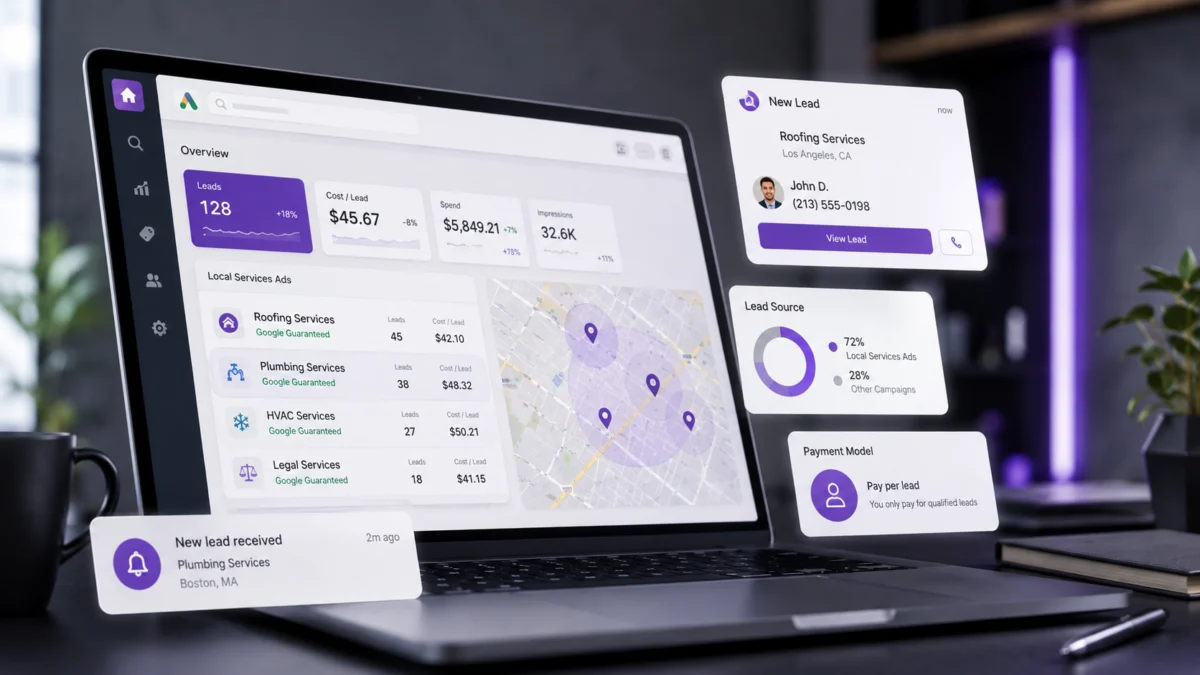
TL;DR: Google is moving Local Services Ads into the Google Ads platform. Beginning in August 2026, select U.S. Local Services Ads accounts will be migrated into a specialized Performance Max campaign with pay-per-lead goals. The familiar pay-per-lead model will remain, and ads will continue appearing on Google Search and Google Maps. However, advertisers will see meaningful changes to campaign management, budgets, bidding and historical reporting.
For contractors and local service businesses that rely on Google Local Services Ads, one of the biggest Google Ads changes in years is officially underway.
Google is beginning the process of bringing Local Services Ads directly into the Google Ads interface.
The first migrations begin in August 2026 for a limited group of U.S. home and storefront service advertisers. Additional businesses will transition later in 2026, with remaining categories and international accounts moving during 2027.
At first glance, this may sound like Google is simply moving Local Services Ads from one dashboard to another.
There is more to it than that.
The transition changes how Local Services campaigns are structured, how budgets are managed, how advertisers bid for leads and where campaign reporting will live.
For businesses already using Local Services Ads, now is the time to understand what is changing.
Are Local Services Ads Becoming Performance Max Campaigns?
Yes, but there is an important distinction.
Existing Local Services Ads campaigns will eventually be migrated into a specialized type of Performance Max campaign optimized for pay-per-lead goals.
That does not mean your Local Services Ads are suddenly going to start appearing across YouTube, Gmail and Google’s Display Network.
Google says the new pay-per-lead Performance Max campaigns will continue serving exclusively within the local placements currently associated with Local Services Ads, including Google Search and Google Maps.
The campaigns will also remain keywordless.
Instead of advertisers choosing traditional search keywords, Google will continue using information such as your services, service areas and Google Business Profile to determine when your business is eligible to appear.
Most importantly, Local Services Ads will remain pay-per-lead.
Advertisers will continue paying for valid customer leads rather than paying every time somebody clicks the advertisement.
What Is Staying the Same?
For most businesses, several of the fundamentals that made Local Services Ads different from regular Google Ads will remain intact:
- You continue paying for valid leads rather than clicks.
- Ads continue appearing primarily to high-intent local customers.
- Local Services placements remain on Google Search and Google Maps.
- Campaigns remain keywordless.
- Service categories and service areas continue helping Google determine which searches are relevant.
- Eligible businesses can continue displaying Google’s verification badge where available.
So despite the Performance Max name, this is not simply a conventional Performance Max campaign with an LSA label attached to it.
Google is essentially bringing the Local Services advertising system into the broader Google Ads infrastructure.
What Is Changing With Local Services Ads?
This is where advertisers need to pay attention.
1. Local Services Ads Will Be Managed Inside Google Ads
Businesses will eventually manage Local Services campaigns, budgets, targeting settings and customer inquiries directly from Google Ads rather than relying on the separate Local Services Ads dashboard.
For businesses running both traditional Google Search campaigns and Local Services Ads, this should create a more centralized advertising environment.
That could make it easier to compare lead generation channels, manage budgets and oversee multiple Google advertising campaigns from one account.
2. Weekly Budgets Are Becoming Daily Budgets
Local Services Ads have traditionally been managed around average weekly budgets.
Following migration, Google will convert those budgets into daily average budgets.
Google says the existing weekly budget will be divided by seven to establish the new daily average. Monthly spending will then be capped using Google’s standard calculation of the daily budget multiplied by 30.4.
Daily spending can still fluctuate based on customer demand.
For contractors, that means looking only at what Google spends on a particular day may be misleading. Campaign performance should be evaluated over a larger period.
3. Manual Maximum Cost-Per-Lead Bidding Is Going Away
This may be one of the biggest operational changes.
Google says manual bidding options such as setting a maximum cost per lead will no longer be supported after migration.
Instead, bidding will operate within Google’s automated bidding system.
For businesses accustomed to controlling how much they are willing to pay for an individual Local Services lead, this represents a significant change.
It also continues a much broader direction inside Google Ads: increasing reliance on automated bidding and machine-learning-driven campaign optimization.
4. Target CPA Will Be Managed at the Campaign Level
Businesses advertising multiple service categories should pay particular attention to this change.
Google Ads will not support separate vertical-level Target CPA settings inside the same migrated campaign.
Instead, Google will calculate a unified campaign-level Target CPA.
For example, an HVAC company that currently wants to pay different amounts for an air conditioning replacement lead and a furnace repair lead may need to rethink its campaign architecture.
Google specifically notes that advertisers who want separate bidding rules for different service categories can create separate campaigns for each vertical.
This could make campaign structure substantially more important for multi-service contractors.
5. Your Historical LSA Reporting Will Not Move With You
This is probably the most immediate action Local Services advertisers should take.
Google says previous Local Services Ads campaign reporting will not migrate into Google Ads.
That includes historical performance information such as:
- Spend
- Leads
- Impressions
- Clicks
- Weekly performance
- Previous ad-level reporting
Businesses should therefore export and save their historical Local Services Ads reporting before migration.
Once the account transitions, marketers will want that historical data available to establish benchmarks and determine whether performance improved or declined after the change.
When Will Google Move Local Services Ads Into Google Ads?
Google currently lists the rollout in three broad stages.
August 2026: Migration begins with select U.S. home and storefront service businesses, including industries such as plumbing, HVAC, electrical, roofing, pest control, lawn care, moving, appliance repair and house cleaning.
Late 2026: Google expands migration to more advertisers, including additional service-area businesses and accounts using more complex bidding or booking configurations.
2027: Remaining categories and non-U.S. advertisers transition into Google Ads.
Google says account administrators will receive an email approximately 14 days before their scheduled migration, along with notifications inside the existing Local Services Ads dashboard.
Will This Change Where Local Services Ads Appear?
According to Google, no.
The migrated campaigns will continue appearing in the same types of Local Services placements on Google Search and Google Maps.
This is an important difference between these campaigns and standard Performance Max.
A traditional Performance Max campaign can distribute ads across Google’s broader advertising ecosystem, including Search, Maps, YouTube, Gmail, Discover and the Display Network.
The new Performance Max campaigns with pay-per-lead goals are much more restricted.
They are specifically designed around local service lead generation.
What Does This Mean for Contractors and Home Service Companies?
For roofing companies, HVAC contractors, plumbers, electricians, fence companies, landscapers and other home service businesses, we don’t view this as a reason to abandon Local Services Ads.
Local Services Ads can still be an extremely valuable source of high-intent leads.
But the transition reinforces something we have been telling clients for years:
You should not build your entire lead generation strategy around one Google advertising product.
A strong local digital marketing strategy should generally create visibility across multiple parts of the search results.
Depending on the market, that may include:
- Google Local Services Ads
- Google Search Ads
- Google Business Profile and the local Map Pack
- Organic search results
- Strong service and location pages
- Remarketing
- Brand search visibility
Someone searching for a contractor today may see several different Google experiences before deciding whom to contact.
Winning locally increasingly means creating a strong overall digital footprint, rather than relying on a single campaign type.
What Should Current Local Services Advertisers Do Now?
If your company currently runs Local Services Ads, we recommend doing a few things before Google migrates your account.
Export your historical data. Save lead volume, spend, cost per lead and other meaningful performance benchmarks before the old reporting disappears.
Review your service categories. Make sure Google accurately understands the services you actually want leads for.
Review your service areas. Don’t simply target every location available. Focus advertising on markets where you realistically want to generate business.
Document your current cost per lead. You’ll want a reliable baseline for comparing performance after migration.
Review multi-service campaigns. Businesses advertising significantly different service categories may benefit from separating campaigns when different CPA targets are required.
Watch for Google’s migration notification. Account administrators should receive advance notice before the transition begins.
Google also cautions that campaigns may need as much as two weeks after migration for performance to stabilize, so advertisers should avoid judging the new campaign structure based solely on the first few days of data.
Is Google Getting Rid of Local Services Ads?
No.
Despite some understandable confusion around the Performance Max terminology, Google is not eliminating the Local Services Ads advertising model.
Instead, it is moving Local Services Ads into Google Ads and rebuilding them as specialized Performance Max campaigns with pay-per-lead goals.
The Local Services concept remains:
Local customers. Local service categories. Search and Maps visibility. Pay for valid leads.
What is changing is the technology and campaign-management infrastructure behind it.
Our Take
For most local service businesses, the biggest benefit is straightforward: Google Ads, Local Services campaigns and lead management will increasingly live under one roof.
The tradeoff is that advertisers are giving Google more control over bidding and campaign optimization.
That makes measurement even more important.
Don’t judge success by whether Google says a campaign is “optimized.”
Judge it by what matters to the business:
How many qualified opportunities did we generate? What did those opportunities cost? And how many became profitable customers?
That should remain the standard regardless of what Google calls the campaign.
Bradford Strategies helps established service businesses build stronger online visibility through Local SEO, Google Business Profile Management, Google Ads, Local Services Ads and conversion-focused websites.
As Google continues changing how local businesses appear in Search, the goal remains the same: build a strong digital foundation that consistently puts your company in front of the right customers.
Get in touch with us today and talk directly to Brad, founder of Bradford Strategies – 20 year career marketer – who knows the ins and outs of local business and how to get your company in front of the right audience to gain visibility and grow your business.
Frequently Asked Questions
Are Local Services Ads moving into Google Ads?
Yes. Google is beginning to migrate Local Services Ads into the Google Ads platform starting in August 2026, with additional advertisers transitioning through 2027.
Will Local Services Ads become Performance Max campaigns?
Yes. Existing campaigns will transition into a specialized Performance Max campaign type designed specifically around pay-per-lead goals.
Will Local Services Ads still charge per lead?
Yes. Google says migrated campaigns will maintain the pay-per-lead model rather than switching to standard cost-per-click billing.
Will Local Services Ads start appearing on YouTube or Display?
No. Google says Performance Max campaigns with pay-per-lead goals will continue serving specifically on Google Search and Google Maps rather than across the full Performance Max network.
Do I need to save my old Local Services Ads reports?
Yes. Historical Local Services Ads campaign reporting will not automatically transfer into Google Ads, so businesses should export their existing performance data before migration.
Want this applied to your market?
We connect blog ideas back to the system: local SEO, Google Business Profile, AI visibility, and conversion-ready sites.