
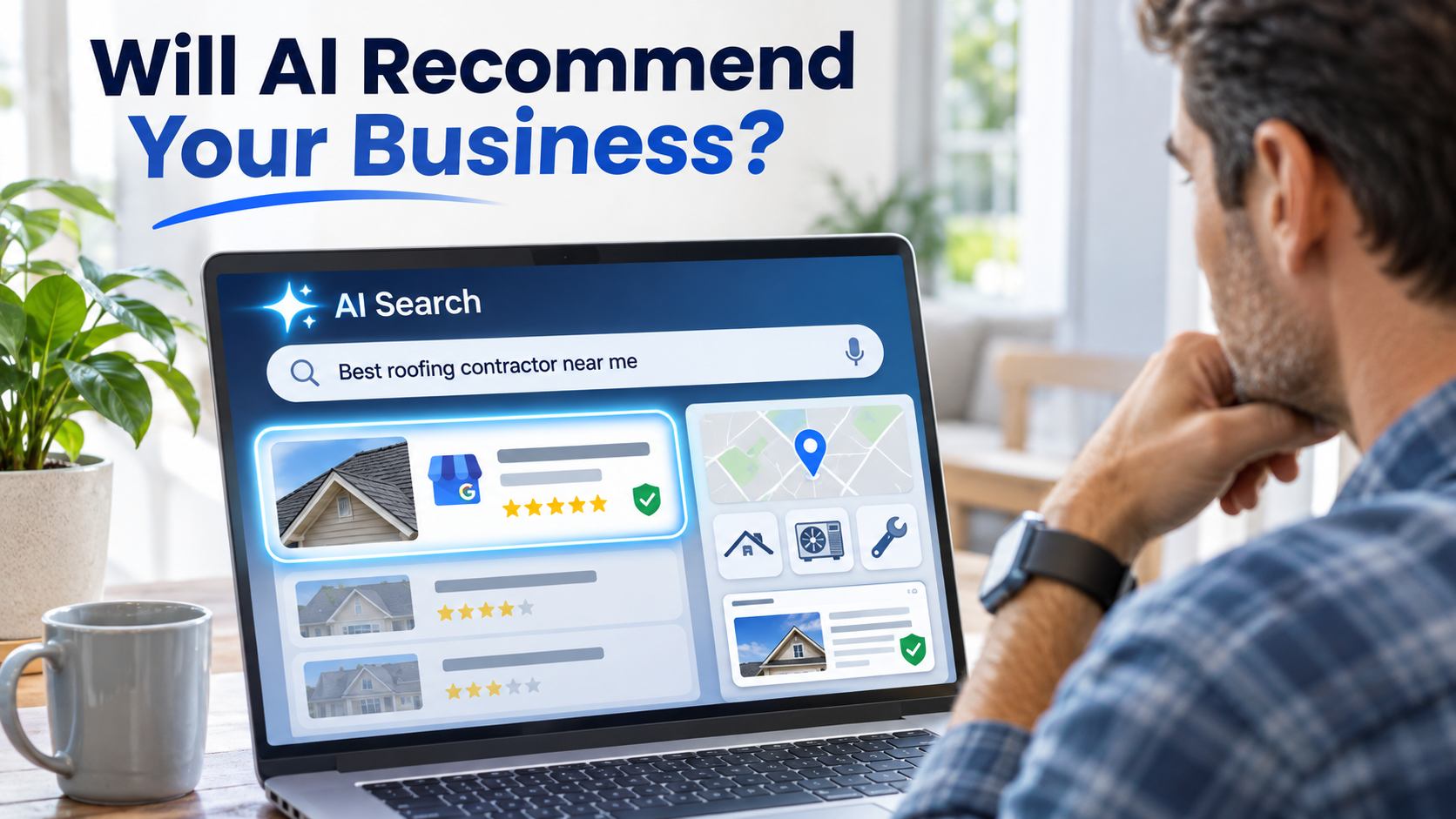
AI is changing how homeowners find contractors. Is your business giving these systems enough information to recommend you?
For years, the goal of local digital marketing was relatively straightforward: get your business ranking on Google, appear in the Map Pack, maintain good reviews, and make it easy for customers to contact you.
Those fundamentals still matter. But the way homeowners search for and evaluate contractors is evolving.
Instead of simply searching for “roofing contractor near me,” a homeowner might ask ChatGPT, Google Gemini, or another AI-powered search tool something more specific:
“Who is a reliable roofing contractor in my area that specializes in older homes and has good customer reviews?”
That is a different kind of search. The homeowner isn’t necessarily looking for a list of websites. They’re asking for a recommendation.
As we head into 2027, home service businesses need to consider an important question: Does your online presence provide enough credible information for AI search tools to understand your business and potentially recommend it?
AI Search Isn’t Replacing Local SEO. It’s Building on It.
There’s plenty of discussion about AI SEO, Answer Engine Optimization (AEO), and Generative Engine Optimization (GEO). While the terminology is new, much of the underlying work should sound familiar.
AI-powered search experiences can draw from websites, search indexes, business listings, and other publicly available information to formulate answers. Different platforms use different sources and methods, so appearing in one AI search tool doesn’t guarantee visibility in another.
Google itself has stated that established SEO best practices remain relevant to its AI-powered search features.
For contractors, this means the foundation of a strong digital presence hasn’t suddenly become obsolete.
Your website still matters. Your Google Business Profile still matters. Your reviews, business information, services, and reputation all contribute to how easily customers and search systems can find and understand your company.
The difference is that businesses should think beyond ranking for individual keywords and focus on communicating who they are, what they do, where they work, and why customers should trust them.
Your Google Business Profile Is Still Essential
For local contractors, a well-maintained Google Business Profile is one of the most valuable digital assets available.
Google uses factors including relevance, distance, and prominence to determine local rankings. Complete business information, appropriate categories, reviews, and accurate contact details all support traditional local search visibility.
While a strong profile doesn’t guarantee an AI recommendation, it provides valuable information that can support your broader online presence.
Contractors should regularly review their profiles to confirm that services, business hours, service areas, photos, and other information accurately reflect their operations.
A roofing company that also installs skylights and gutters should make those services clear. An HVAC contractor specializing in ductless mini-splits should communicate that expertise.
These details help distinguish one business from another.
Customer Reviews Provide More Than Social Proof
Reviews have always influenced purchasing decisions, particularly for expensive home improvement projects.
But their value extends beyond a five-star rating.
Detailed customer feedback can provide useful context about your business. A review describing a successful furnace replacement, an emergency plumbing repair, or a complicated roof installation communicates more than a generic statement about great service.
For that reason, contractors should consistently request genuine reviews from customers and respond professionally to feedback.
The goal isn’t to manufacture keywords or coach customers into writing specific phrases. It’s to develop an authentic body of feedback that reflects the work your company performs.
A business with an established reputation and detailed customer experiences offers more useful information to both prospective customers and search platforms.
Your Website Needs to Explain What You Actually Do
One of the most common weaknesses we encounter on contractor websites is a lack of meaningful service-specific content.
A company might advertise roofing, siding, gutters, and skylights while providing only a few sentences about each service.
That doesn’t give homeowners much information to evaluate, and it limits the amount of useful context search systems can discover.
Consider the difference between a generic page titled “HVAC Services” and a dedicated page explaining ductless mini-split installations, suitable applications, installation considerations, and the company’s experience with those systems.
The second page answers more specific questions and demonstrates greater familiarity with the service.
This is particularly important as search queries become more conversational.
Homeowners may ask about particular problems, equipment, property types, or situations rather than searching for a broad service category.
Your website should answer those questions clearly, accurately, and based on actual experience.
Structured Data and Consistent Business Information Matter
Behind the scenes, technical website elements also help search engines understand a business.
Structured data, commonly referred to as schema markup, provides machine-readable information about your company, website, and services.
Appropriate markup can clarify details such as your business identity, contact information, and service offerings. However, schema isn’t a shortcut to AI visibility, and there is no special markup that guarantees inclusion in AI-generated results.
Consistency is equally important.
Your company name, address where applicable, phone number, website, and service information should be accurate across your website, Google Business Profile, and other relevant business listings.
Conflicting or outdated information creates unnecessary confusion for customers and makes your online presence less dependable.
These aren’t glamorous marketing tasks, but they are foundational.
Real Experience Is Becoming More Valuable
The internet is already flooded with generic marketing content, and AI has made it easier than ever to produce more of it.
What is considerably harder to replicate is legitimate, firsthand experience.
Original project photographs, documented installations, customer testimonials, detailed service explanations, and answers to common questions all help demonstrate that a contractor actually performs the work being described.
A roofing contractor explaining an unusual roof replacement, or an HVAC company documenting a difficult installation, provides information that generic content cannot easily replace.
That experience should be part of your website and broader digital presence.
It doesn’t require publishing an endless stream of articles. It requires making the work you’re already doing visible, understandable, and useful to prospective customers.
Preparing for 2027 Starts With the Fundamentals
At Bradford Strategies, we don’t view AI search optimization as an entirely separate marketing service disconnected from traditional SEO.
We see it as another reason to invest in a strong, accurate, and credible digital presence.
A contractor’s website, Google Business Profile, reviews, local visibility, and service content should work together. Each contributes to a clearer picture of the business and a better experience for potential customers.
There is no guaranteed formula for getting recommended by ChatGPT, Gemini, or Google’s AI-powered search features. These systems continue to evolve, and their responses can vary depending on the question, location, and available information.
What businesses can control is the quality of the information they publish and the strength of their digital reputation.
The objective shouldn’t simply be to convince AI that your company is worth recommending. It should be to build an online presence that gives both homeowners and search systems legitimate reasons to trust your business.
That’s good marketing today, and it’s a sensible foundation for 2027.
Is Your Business Ready for the Next Phase of Local Search?
Bradford Strategies helps home service businesses connect website development, local SEO, Google Business Profile optimization, content strategy, and paid advertising into a coordinated marketing approach.
With more than 20 years of marketing experience, we focus on understanding your business first, identifying opportunities, and building strategies that support measurable growth, and we always take a more consultative approach. Every business is different, and we can tailor a plan to fit your specific needs.
Schedule a consultation call with us to discuss where your business stands and where improvements could make the biggest difference.
Want this applied to your market?
We connect blog ideas back to the system: local SEO, Google Business Profile, AI visibility, and conversion-ready sites.