
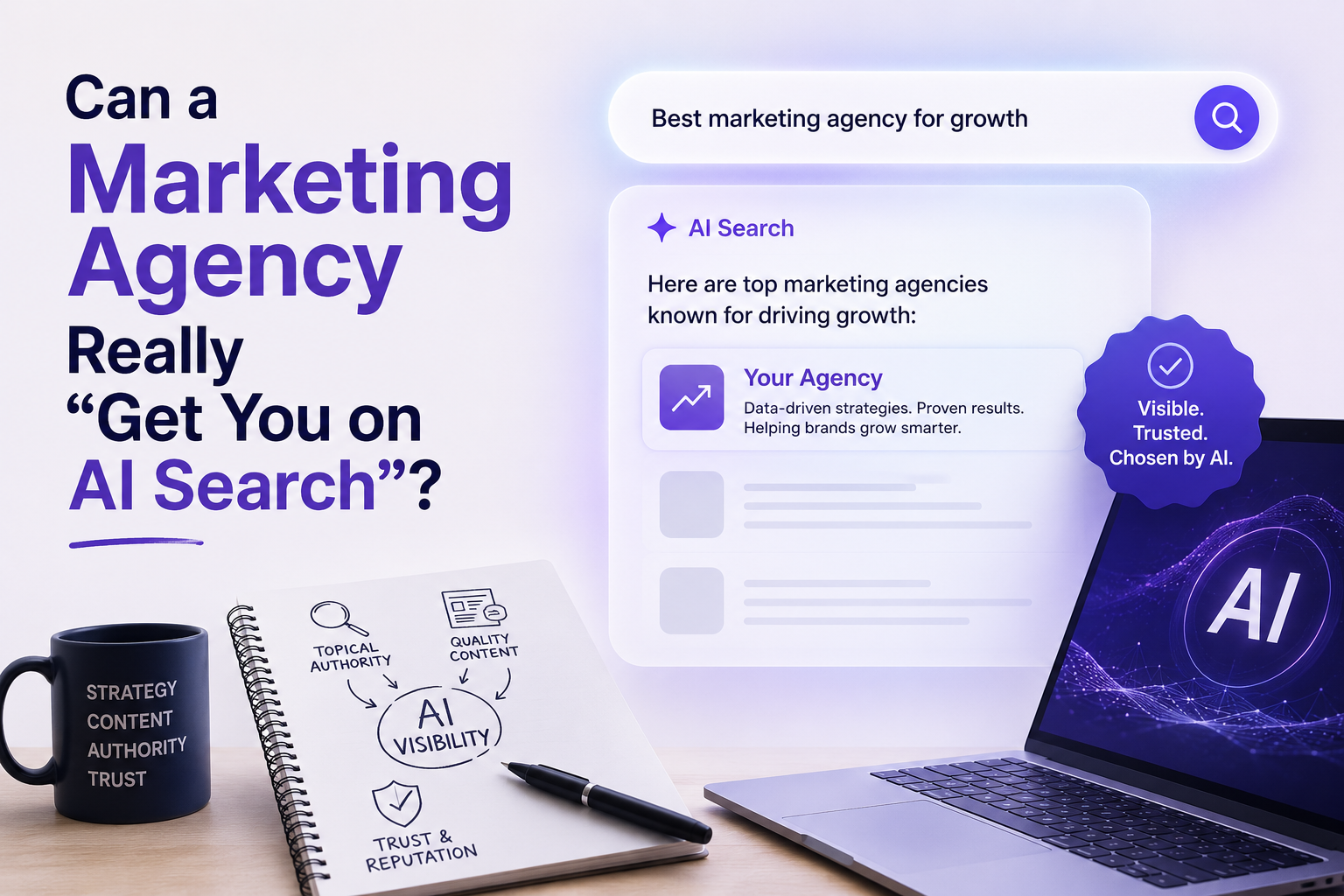
Over the last year, business owners have started asking a new version of an old question:
“How do we show up in ChatGPT?”
“How do we get found in AI search?”
“Can you optimize us for AI?”
There is a real answer to this, but it is getting buried under a lot of noise.
Some agencies are acting like AI visibility is a secret system they have access to. Others are dismissing it completely. Neither position is accurate.
A business absolutely can improve its visibility across AI-driven search platforms. But there is no magic switch, no guaranteed placement, and no universal “AI ranking” system.
That is the part many people are skipping over.
AI Search Is Not a Single Platform
When people talk about “AI search,” they usually lump everything together:
- Google AI Overviews
- ChatGPT Search
- Gemini
- Perplexity
- Bing Copilot
- Voice assistants
- AI-generated summaries inside browsers and apps
The problem is these platforms do not work the same way.
They pull from different sources.
They weigh authority differently.
They update constantly.
They generate different answers for different users.
There is no master dashboard where an agency submits your company to “the AI.”
That does not exist.
What does exist is a growing shift in how information is evaluated online.
AI systems are trying to determine whether your business appears legitimate, trustworthy, consistent, and relevant across the web.
That changes the conversation completely.
Strong Businesses Tend to Have Strong Digital Footprints
A lot of business owners still think SEO is mainly about keywords and rankings.
That was already becoming outdated before AI entered the picture.
Today, search systems are looking at the bigger picture.
They are trying to understand:
- What your company actually does
- Where you operate
- Whether your information is consistent
- Whether people appear to trust you
- Whether your business is referenced elsewhere online
- Whether your website clearly supports your claims
This is why some businesses with decent-looking websites barely show up in AI-generated answers, while others appear constantly.
The difference is usually not one trick.
It is the overall strength of the business’s digital presence.
Your Website Still Matters More Than Most People Think
There has been a strange trend lately where people act like websites are becoming less important because of AI.
In reality, the opposite is happening.
AI systems still rely heavily on websites to understand businesses properly.
If your site is thin, confusing, outdated, slow, or poorly organized, it becomes harder for search systems to trust what they are seeing.
That includes basics like:
- Clear service pages
- Proper location pages
- Fast load times
- Mobile usability
- Logical navigation
- Internal linking
- Structured content
- Crawlable pages
- Consistent business information
A visually attractive site is not automatically a strong site.
Some beautiful websites provide almost no usable information for search engines or AI systems.
Google Business Profile Is Still One of the Biggest Pieces
For local businesses, Google Business Profile still carries enormous weight.
A surprising number of companies either neglect it entirely or treat it like a one-time setup task.
That is a mistake.
AI systems heavily rely on local trust signals, including:
- Accurate business information
- Review quality and consistency
- Categories
- Service descriptions
- Photos
- Geographic relevance
- Posting activity
- Third-party directory consistency
This is especially true for home service businesses.
If your online information is inconsistent, incomplete, or confusing, it weakens confidence across the board.
Content Still Matters, But Not the Way It Used To
One of the worst things happening right now is the flood of generic AI-written content being pushed onto the internet.
Businesses are publishing massive amounts of filler because they think volume alone will improve visibility.
Most of it reads the same.
Most of it says nothing useful.
Most of it exists purely to satisfy a content calendar.
Search systems are getting better at recognizing that.
The businesses that tend to perform better are the ones creating content around real questions and real situations.
Not keyword stuffing.
Not robotic “ultimate guides.”
Just useful information written by people who clearly understand their industry.
That could include:
- Explaining common customer concerns
- Breaking down processes
- Answering local questions
- Comparing options
- Showing project examples
- Explaining pricing factors
- Discussing industry changes
The goal is not to trick search engines.
The goal is to build enough useful information that your business starts becoming a trusted reference point.
Multi-Channel Presence Matters More Than It Used To
This is one area that many businesses still underestimate.
For years, companies treated every platform separately.
The website was one thing.
Social media was another.
Google Business Profile lived on its own island.
Directory listings were an afterthought.
AI systems do not really view businesses that way anymore.
They look for consistency across the web.
That means your business information, branding, messaging, and activity should generally line up across:
- Your website
- Google Business Profile
- YouTube
- Industry directories
- Press mentions
- Local citations
The web starts building a clearer picture of who you are.
That matters more than most people realize.
Does Social Media Actually Help AI Visibility?
This is where people tend to oversimplify things.
Some social platforms are heavily crawlable. Others are more restricted. Social content itself is not always indexed the same way traditional web pages are.
But that does not mean social media is irrelevant.
Far from it.
Strong social activity can indirectly strengthen visibility in several ways.
Brand Recognition
A business that regularly publishes useful, relevant content tends to look more legitimate online than a business that appears abandoned.
That sounds obvious, but it matters.
AI systems are increasingly trying to determine whether businesses appear active and established.
Reinforcing Business Identity
Consistent information across platforms helps systems better understand your business.
Your services, locations, branding, staff, and expertise start getting reinforced repeatedly across the web.
That creates stronger entity recognition over time.
Content Distribution
Social media still helps distribute ideas, project photos, videos, and educational content.
That can lead to:
- Brand searches
- Shares
- Backlinks
- Mentions
- Referral traffic
- Press opportunities
All of those things strengthen overall digital authority.
Video Is Becoming More Important
Video content continues to grow in importance across search and AI ecosystems.
YouTube especially carries significant weight because it is searchable, crawlable, and tied directly into Google’s ecosystem.
Businesses showing real projects, real people, and real expertise generally build more trust than businesses relying entirely on stock imagery and generic writing.
The Biggest Problem Right Now: AI Marketing Hype
The market is moving so quickly that many business owners are struggling to separate reality from sales language.
That creates opportunities for agencies to overpromise.
You are seeing phrases like:
- “Guaranteed AI rankings”
- “Get featured in ChatGPT”
- “AI submission services”
- “AI search domination”
- “AI authority systems”
Most of that is just repackaged marketing language.
No agency controls ChatGPT.
No agency controls Google AI Overviews.
No agency controls Gemini.
And these systems change constantly.
A credible agency should be honest about that.
What Good Agencies Are Actually Doing
The agencies worth paying attention to are usually focused on strengthening the entire digital ecosystem around a business.
That includes:
- Technical SEO
- Website structure
- Google Business Profile optimization
- Content strategy
- Local SEO
- Review development
- Citation consistency
- Conversion tracking
- Reputation management
- Multi-platform visibility
- Authority building
None of that sounds flashy.
That is probably a good sign.
Because most long-term visibility online still comes from doing foundational things correctly and consistently.
AI search is changing how information gets surfaced, but it is not replacing the importance of trust, clarity, and authority.
If anything, those things matter more now.
Measuring AI Visibility Is Still Messy
Another thing businesses should understand:
AI visibility tracking is still early.
There are tools trying to measure:
- AI mentions
- AI referrals
- Citation frequency
- Prompt visibility
- Share of voice
Some are useful. Some are mostly guesswork.
Nothing currently exists at the level of maturity businesses are used to with Google Analytics or traditional SEO reporting.
That does not mean AI visibility is fake. It just means the measurement side is still catching up.
Final Thoughts
Can a marketing agency improve your visibility across AI-driven search systems?
Yes.
Can they guarantee you placement inside ChatGPT or Google AI results?
No legitimate agency should promise that.
The businesses that are adapting best right now are usually the ones focusing on the bigger picture:
- A strong website
- Clear information
- Consistent branding
- Real expertise
- Useful content
- Active profiles
- Strong reviews
- Multi-channel visibility
- Technical stability
AI systems are increasingly evaluating businesses the way people do.
Not based on one isolated ranking signal, but based on whether the business appears credible across the web as a whole.
That is where this is heading.