
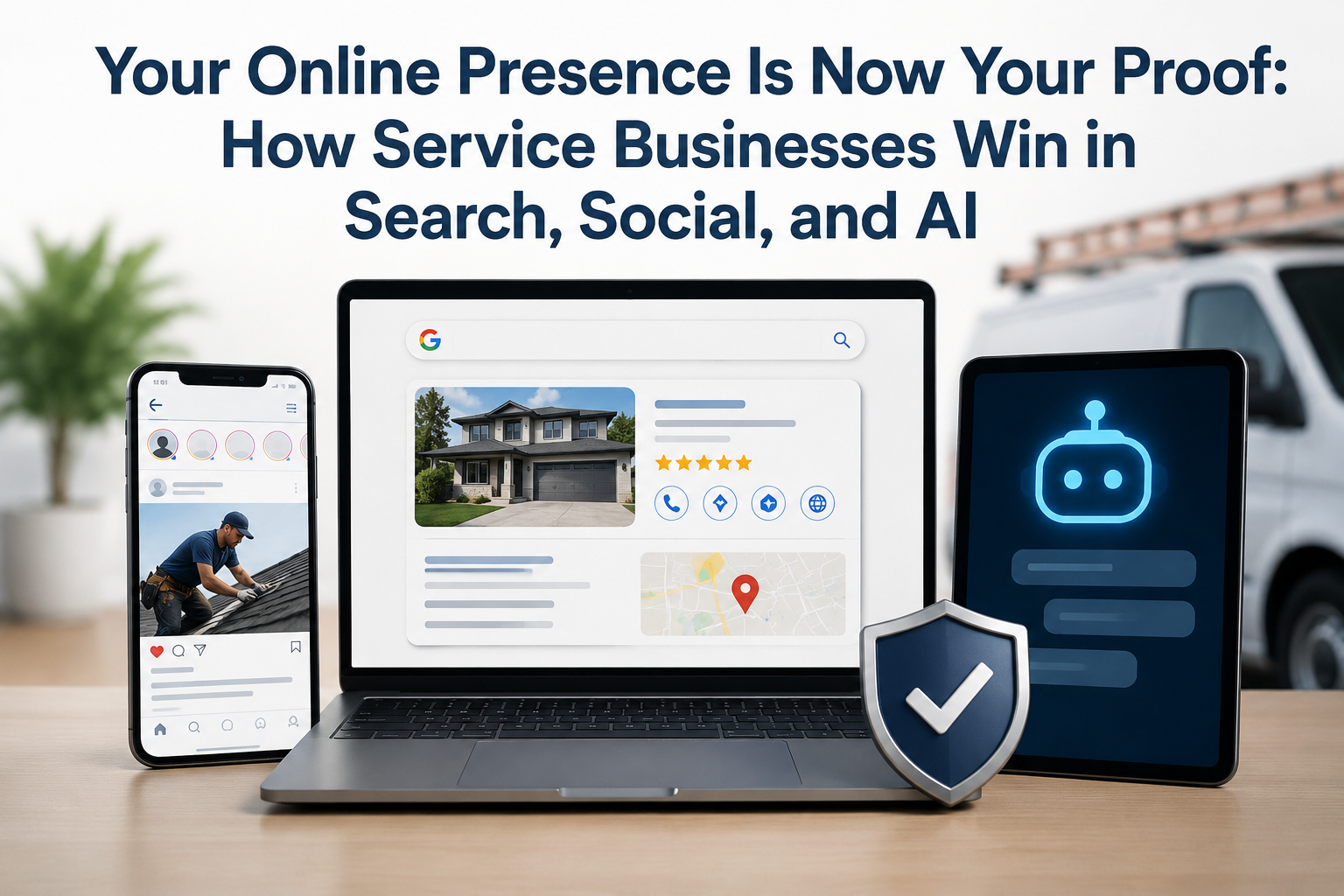
For years, local digital marketing was treated like a checklist.
Build a website.
Optimize the Google Business Profile.
Get reviews.
Post occasionally on social media.
Run ads when leads slow down.
That approach is no longer enough.
Search is changing because the way people find, compare, and choose service businesses is changing. Google is still incredibly important, but it is no longer the only place customers gather information. AI search tools, Google AI Overviews, ChatGPT, Perplexity, Gemini, social platforms, map results, review sites, directories, YouTube, Reddit, and community conversations are all becoming part of the decision-making process.
For service businesses, this matters.
A homeowner looking for a roofer, HVAC company, remodeler, electrician, landscaper, fence installer, paving contractor, plumber, marine service company, med spa, wellness provider, or professional service firm is not always following the old path of “search, click, call.”
They may see a Google Business Profile first.
They may ask an AI tool for recommendations.
They may check Instagram to see recent work.
They may look at Facebook reviews.
They may watch a YouTube video.
They may scan Reddit, local groups, directories, or social posts.
They may never visit five different websites before making a decision.
The businesses that win in this new environment are not the ones that only “rank.”
They are the ones that look real, active, consistent, trustworthy, and easy to understand across the entire web.
That is where social media has become more important than many service businesses realize.
Not because every post will go viral.
Not because likes pay the bills.
Not because every contractor, professional, or local business owner needs to become an influencer.
Social media now acts as proof of life.
It supports your Google Business Profile. It reinforces your website. It gives customers and search systems fresh evidence that your business is active. It helps AI tools understand who you are, what you do, where you work, and whether your company appears legitimate.
Local visibility is no longer one channel.
It is an ecosystem.
For most service businesses, the Google Business Profile is still one of the most important digital assets you own.
When someone searches for “roof repair near me,” “emergency plumber,” “custom fence installer,” “driveway paving company,” “marine electronics installation,” “HVAC repair,” or “kitchen remodeler,” the map results are often the first serious battleground.
Google Business Profile Is Still the Local Foundation
Google’s own local ranking guidance points to three major factors: relevance, distance, and prominence. Google also notes that complete and accurate business information helps customers understand what a business does, where it is located, and when it is available.
That means the basics still matter.
Your categories need to be accurate.
Your services need to be filled out.
Your description should clearly explain what you do.
Your photos should reflect real work.
Your reviews should be recent and specific.
Your service areas should make sense.
Your hours, phone number, website, and business details need to stay consistent.
But Google Business Profile alone is not the whole game anymore.
A Google Business Profile can tell Google and customers that your business exists. It can show your location, services, reviews, and photos. But it does not always tell the full story of your work, your expertise, your process, your team, your values, or your consistency.
That is where your website, reviews, and social media need to support the profile.
Your Website Explains. Your Google Profile Validates. Your Social Media Proves You Are Alive.
A strong local visibility strategy needs each channel to do its job.
Your website should be the clearest and most complete source of truth. It should explain your services, your service areas, your process, your differentiators, your FAQs, your proof, and your conversion paths.
Your Google Business Profile should help you appear in local search and Maps when people are looking for a nearby provider.
Your reviews should provide third-party trust and show that real customers have had real experiences with your company.
Your social media should show that the business is active right now.
That last point is where many service businesses underestimate social.
A Facebook page, Instagram profile, YouTube channel, LinkedIn page, or other social presence with recent project photos, service reminders, customer education, team updates, short videos, and real-world examples sends a simple signal:
This company is doing the work.
For a service business, that matters more than polished branding alone.
A homeowner does not just want to know that you offer roof replacement. They want to see that you were on a roof last week.
A property owner does not just want to know that you install fences. They want to see completed fence projects in real yards.
A business owner does not just want to know that you offer commercial services. They want to see signs that your company is active, organized, and trusted.
A boat owner does not just want to know that you install electronics. They want to see real helm upgrades, clean wiring, and finished installs.
A customer looking for a remodeler does not just want a generic service page. They want current before-and-after proof.
Social media fills that gap.
It makes the business feel current.
AI Search Has Changed the Meaning of Online Presence
AI search tools do not behave exactly like traditional search engines.
Traditional SEO was largely built around ranking web pages. AI search is more about understanding entities, summarizing answers, comparing options, and pulling together information from multiple sources.
That does not mean AI tools are perfect. They are not. AI-generated answers can be incomplete, inconsistent, or wrong.
But the direction is clear: customers are starting to use AI tools as part of research and decision-making.
Instead of typing one keyword into Google, people may ask questions like:
“Who are the best roofers near me?”
“What should I look for in a paving contractor?”
“Is this HVAC company reputable?”
“Which fence company has good reviews?”
“Who installs marine electronics in my area?”
“What local businesses seem trustworthy for basement remodeling?”
“Which company should I call for this problem?”
AI systems may look at websites, business profiles, reviews, directories, articles, social content, videos, maps data, and other public information to form an answer.
The exact mix changes by platform, query, location, and available sources.
This is why the old idea of “we have a website, so we’re good” is fading.
A website is essential. But AI visibility depends on a broader footprint.
Social Media Is Becoming a Trust Layer, Not Just a Marketing Channel
For years, many business owners viewed social media as optional.
That was understandable.
For a roofer, electrician, paving company, fence installer, HVAC company, marine service provider, remodeler, wellness practice, or professional service firm, social media often felt like extra work with unclear return.
But in the AI and local search era, social media should be viewed differently.
It is not just a place to chase engagement.
It is a public trust layer.
A steady social presence can show:
Recent projects
Service areas
Crew activity
Customer education
Seasonal expertise
Before-and-after proof
Company personality
Community involvement
Consistency over time
This matters to people.
It also matters to search systems.
Google now allows businesses to manage social media links directly inside their Business Profile. Google also supports Business Profile posts such as updates, offers, and events. That alone should tell business owners something important: social profiles and business updates are part of how a local business is understood online.
Social does not replace your Google Business Profile.
It supplements it.
Social does not replace SEO.
It supports it.
Social does not replace reviews.
It adds context around them.
A review says, “This customer had a good experience.”
A website says, “This is what we offer.”
A Google Business Profile says, “This business exists in this market.”
Social says, “This business is active, visible, and doing the work now.”
That combination is powerful.
Proof of Life Is Especially Important for Service Businesses
Service businesses have a trust problem.
Customers are often skeptical before they call. They have heard stories about companies that do not show up, contractors who disappear after a deposit, rushed work, poor communication, unclear pricing, and businesses that look professional online but fail in real life.
This is especially true when the service involves real money, property risk, urgency, health, safety, or high personal trust.
A stale digital presence makes that skepticism worse.
Imagine two companies.
Company A has a decent website, but the last blog post is from 2021. The Google Business Profile has a few reviews, but no recent photos. The Facebook page has not been updated in eight months.
Company B has a clear website, a complete Google Business Profile, recent reviews, current jobsite photos, short videos from projects, seasonal tips, and posts showing real work in real communities.
Even before reading every detail, Company B feels more alive.
That does not automatically mean Company B is better.
But perception matters.
Trust starts before the call.
The same applies to almost every service category.
Paving companies can show driveway installs, sealcoating jobs, drainage corrections, and parking lot repairs.
Fence companies can show finished vinyl, aluminum, wood, chain link, and privacy fence projects.
HVAC companies can show installs, maintenance calls, emergency repairs, and seasonal reminders.
Marine companies can show electronics installs, repowers, service work, winterization, and spring launch prep.
Remodelers can show progress shots, finished kitchens, bathrooms, decks, basements, and exterior upgrades.
Medical and wellness businesses can show education, staff, environment, process, and patient experience cues.
Professional service firms can show insights, client education, team perspective, and proof that they understand the market they serve.
People want evidence.
AI systems also benefit from evidence.
A business with more consistent public signals is easier to understand, categorize, and trust than a business with thin, outdated, or conflicting information.
AI Does Not Just Read Your Website Like a Human
This is one of the biggest mental shifts business owners need to make.
AI systems do not evaluate a company the same way a human does. They do not simply visit your homepage, admire the design, and decide you look professional.
They work by collecting, interpreting, comparing, and summarizing information.
That means clarity matters.
Consistency matters.
Structure matters.
Repetition across trusted places matters.
Your business needs to be easy to identify across the web.
The name should be consistent.
The phone number should be consistent.
The service areas should make sense.
The services should be described clearly.
The website should match the Google Business Profile.
The Google Business Profile should match the social profiles.
The social profiles should point back to the website.
The website should link to important profiles.
Reviews should reinforce the services you actually want to be known for.
Photos and posts should show the work you claim to do.
If your website says one thing, your Google Business Profile says another, your social profiles are stale, and your online listings conflict, you are making it harder for both customers and AI systems to understand you.
Local visibility rewards clarity.
The New Local SEO Is Entity Building
The old version of local SEO often focused too narrowly on keywords.
Put the city in the title tag.
Add a service area page.
Build some citations.
Post on Google.
Get reviews.
Those things still matter.
But they are not enough by themselves.
The new version of local SEO is entity building.
In plain English, that means making your business a clearly understood “thing” on the internet.
Search engines and AI systems need to understand:
Who you are
What you do
Where you do it
Who you serve
What proof exists
What other sources confirm it
Whether your information is consistent
Whether you appear active and legitimate
This is where digital marketing needs to move away from isolated tactics and toward a connected visibility system.
The goal is not simply to “post more” or “rank higher.”
The goal is to create a digital footprint that makes your business easier to find, easier to trust, and easier to choose.
Why Social Content Supports Google Business Profile
Google Business Profile content is important, but it is limited.
Google posts, photos, services, products, updates, offers, and events are useful. They help keep the profile fresh and provide customers with timely information.
But Google Business Profile alone does not always give you enough room to tell the full story.
Social media gives you more flexibility.
You can post project photos.
You can share reels.
You can show crews in the field.
You can explain common problems.
You can answer FAQs.
You can show seasonal reminders.
You can highlight towns served.
You can repurpose blog content.
You can show brand personality.
You can document progress over time.
Then your Google Business Profile can act as the local search anchor while social adds freshness and depth.
For example, a roofing company might use Google Business Profile to highlight emergency roof repair, storm damage tarping, roof replacement, and service areas. Social media can show real storm response, crew videos, completed roof replacements, slate removals, shingle installs, and homeowner education.
A paving company might use Google Business Profile to highlight driveway paving, resurfacing, commercial lots, and sealcoating. Social can show fresh asphalt jobs, drainage issues, crack repair examples, and seasonal maintenance reminders.
A marine service company might use Google Business Profile to highlight electronics installation, trolling motors, audio systems, repowers, and service work. Social can show real boats, helm upgrades, wiring, installs, and sea trials.
A remodeling company might use Google Business Profile to define its services and service areas. Social can show the quality, cleanliness, progress, and finished results of real projects.
The website explains the service.
Google captures local demand.
Social proves current activity.
Reviews validate the experience.
That is the ecosystem.
Social Media Also Feeds Branded Search
When someone hears about your business, they often search your name.
This is called branded search, and it is more important than most small businesses realize.
A person may search:
“Company name reviews”
“Company name near me”
“Company name Facebook”
“Company name Instagram”
“Company name complaints”
“Company name before and after”
“Company name Google reviews”
When your branded search results show a complete website, strong Google Business Profile, active social profiles, recent photos, reviews, and consistent information, you look more established.
When the results are thin, outdated, or inconsistent, you look weaker.
Social media helps control more of that brand environment.
It gives search engines more legitimate places to associate with your business. It gives customers more ways to verify you. It gives AI tools more public context.
That does not mean every platform deserves equal effort.
Most service businesses do not need to be everywhere.
But they should be somewhere consistently.
For many local service businesses, Facebook and Instagram still matter because customers are local, visual proof matters, and community sharing is real. LinkedIn can matter for B2B, commercial, recruiting, professional services, and authority building. YouTube can matter when education, demonstration, installation, walkthroughs, or long-term search visibility are valuable.
The platform should match the customer journey.
Reviews Are Still One of the Strongest Trust Signals
Social media can create proof of life, but reviews create proof of experience.
A healthy review profile tells customers that other people have trusted the business and had a positive result.
For local SEO, reviews also help reinforce relevance. A review that mentions the actual service, town, problem, or outcome gives Google and potential customers more context than a generic “great job.”
This is why review generation should not be treated as a random request.
It should be part of the operating system.
Ask at the right time.
Make the review link easy to use.
Encourage honest, specific feedback.
Respond professionally.
Look for patterns in what customers mention.
Use review themes to improve service pages and content.
Reviews, Google Business Profile, website content, and social content should support one another.
A review mentions storm damage roof repair.
The website has a storm damage page.
The Google Business Profile lists storm damage repair as a service.
Social shows recent tarping and repair work after a storm.
That is how a business becomes easier to understand.
Content Depth Still Matters
There is a dangerous myth that AI search means websites no longer matter.
That is wrong.
Websites may matter more, not less, but the type of website that matters is changing.
A thin five-page brochure site with vague service descriptions is not enough. AI tools and customers both need substance.
Your site should answer real questions:
What services do you offer?
What problems do you solve?
What areas do you serve?
What makes your process different?
What should customers expect?
What are common warning signs?
What factors affect pricing?
What materials, systems, brands, or methods do you use?
What questions do customers ask before hiring you?
What proof do you have?
What happens after someone contacts you?
This is where blogs, service pages, FAQs, case studies, project pages, and location pages still matter.
But they need to be written for real customers, not just search engines.
A good blog should help a customer make a better decision.
A good service page should explain the service clearly.
A good location page should be regionally useful, not a copy-paste city swap.
A good FAQ should answer objections before the sales call.
A good project page should prove that you have done the work before.
AI systems are built to summarize answers.
If your business does not publish clear answers, you give those systems less to work with.
Local Markets Are Competitive and Overlapping
Most service businesses do not operate in one neat box.
They serve towns, counties, regions, neighborhoods, and nearby communities. Customers search in different ways depending on how they think about the area.
Some search by town.
Some search by county.
Some search by “near me.”
Some search by region.
Some search by problem.
Some search by service.
Some search by business name after getting a referral.
That creates complexity.
A basic homepage cannot carry all of that.
You need a regional content strategy.
That does not mean creating hundreds of weak city pages. It means building a logical footprint:
Core service pages
Priority service area pages
Project-based content
Google Business Profile service alignment
Localized blog topics
Review language from real customers
Social posts that mention real towns and work examples
Photos that reflect the actual market
For AI and local search, regional clarity is an advantage.
The more clearly your business is associated with the right services in the right places, the stronger your visibility foundation becomes.
The Best Social Content for AI and Local Visibility Is Not Fluff
Most service businesses do not need trendy social content.
They need useful evidence.
The best content is usually simple:
A finished project
A problem found on-site
A before-and-after
A short explanation from the owner
A seasonal warning
A customer question answered
A crew photo
A product or material explanation
A service area highlight
A common mistake to avoid
A quick maintenance tip
A real job in a real town
For example:
“Slate roof removal in Warren County”
“Fresh asphalt driveway completed this week”
“Vinyl fence installation for a local homeowner”
“Emergency roof tarping after storm damage”
“Marine electronics upgrade before boating season”
“Basement remodel progress update”
“Common HVAC issue we are seeing this summer”
“What to check before calling a plumber”
“How to know when it is time to replace your driveway”
This kind of content does multiple jobs.
It speaks to customers.
It creates proof of work.
It gives the business more local context.
It supports branded search.
It gives the team material to reuse on Google Business Profile.
It creates visual trust.
It gives AI and search systems more public evidence.
The goal is not to entertain everyone.
The goal is to make the right customer think, “These people do this work all the time.”
Consistency Beats Intensity
A common mistake is treating digital marketing like a burst of activity.
Post every day for two weeks, then disappear.
Write four blogs, then stop for six months.
Ask for reviews once, then forget.
Update Google Business Profile during a slow season, then ignore it when busy.
That creates a weak signal.
The better approach is consistency.
For most service businesses, a realistic monthly rhythm could look like this:
Two to four Google Business Profile updates
Four to eight social posts
One strong blog, FAQ, case study, or service-area content piece
New project photos added to Google Business Profile
A steady review request process
Website improvements based on real questions and services
Basic tracking of calls, forms, rankings, and leads
This is not glamorous.
It is not a hack.
It is how you build a digital footprint that compounds.
AI Visibility Requires Better Source Material
AI tools can only work with what they can access, interpret, and trust.
If your website is thin, your Google Business Profile is incomplete, your reviews are stale, your social profiles are inactive, and your business information is inconsistent, you are not giving AI systems much to work with.
If your website is clear, your Google Business Profile is complete, your reviews are current, your social channels show real work, and your business appears consistently across the web, you are building stronger source material.
That does not guarantee that ChatGPT, Gemini, Perplexity, Google AI Overviews, or any other AI-driven system will recommend your business every time.
No honest agency should promise that.
But it improves the conditions.
And that is the right way to think about modern visibility.
You are not trying to trick the algorithm.
You are trying to make your business easier to understand, verify, and recommend.
The Strategy: Build a Connected Local Visibility System
For service businesses, the path forward is not complicated, but it does require discipline.
Start with the foundation.
Make sure your website clearly explains your services, service areas, process, proof, and next steps.
Then strengthen the local layer.
Complete your Google Business Profile. Keep services accurate. Add photos. Use updates. Manage reviews. Keep information current.
Then build the trust layer.
Ask for reviews consistently. Respond to them. Use the language customers naturally use to understand what matters.
Then build the social proof layer.
Post current work. Show real projects. Mention real service areas. Educate customers. Repurpose content from jobs, blogs, FAQs, and seasonal needs.
Then connect the pieces.
Link your social profiles on your website. Add social links to your Google Business Profile where available. Use website content to support Google services. Use social content to support website topics. Turn common customer questions into blogs. Turn blogs into posts. Turn projects into proof.
This is how a business becomes more visible across search, maps, social, and AI-driven discovery.
The Bradford Strategies Perspective
At Bradford Strategies, we do not see local marketing as a collection of disconnected tasks.
A website project is not just a design project.
SEO is not just keywords.
Google Business Profile management is not just posting updates.
Social media is not just content for the sake of content.
AI visibility is not a magic add-on.
All of it works together.
The businesses that will win over the next several years are the ones that build a stronger digital footprint now. That means being clear, active, consistent, and trustworthy across the places customers and AI systems look for answers.
Many competitors are still treating their online presence like a static brochure.
Their websites are thin.
Their Google Business Profiles are underused.
Their social pages are stale.
Their reviews are inconsistent.
Their content does not explain their expertise.
Their online presence does not prove that they are active, trusted, and worth choosing.
That leaves room for businesses willing to show up consistently.
Not with gimmicks.
With proof.
Real work.
Real expertise.
Real reviews.
Real service areas.
Real updates.
Real answers.
That is what modern local visibility requires.
And in the age of AI search, that kind of proof is becoming harder to fake and more valuable to build.