
For years, businesses have viewed a website launch as the finish line. The design is approved, the pages are built, the site goes live, and the project is complete.
Today, that mindset can leave a lot of opportunity on the table.
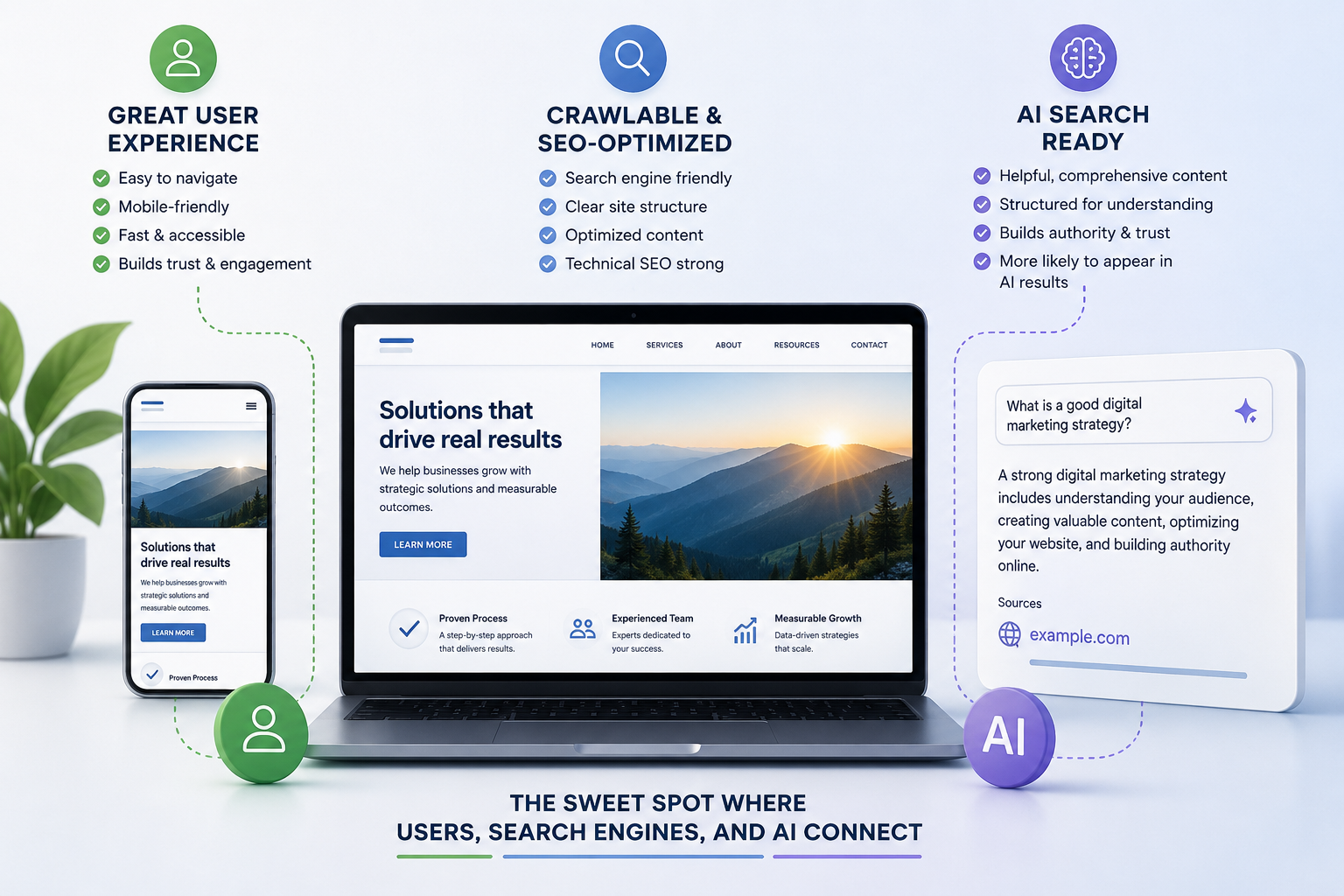
Modern websites need to do much more than look great. They must provide an exceptional experience for visitors, be easily understood by search engines like Google, and increasingly, be structured in a way that allows AI-powered search engines to discover, interpret, and reference your content.
In other words, a beautiful website that nobody can find—or that AI systems cannot understand—is no longer enough.
The most successful websites today are built at the intersection of user experience (UX), traditional SEO, and AI search optimization.
Great Design Means Nothing Without a Great User Experience
A visually impressive website may capture attention, but user experience is what turns visitors into customers.
When someone lands on your website, they are asking questions:
- Am I in the right place?
- Does this company understand my needs?
- Can I easily find the information I’m looking for?
- Do I trust this business enough to contact them or make a purchase?
Your website needs to answer these questions quickly and clearly.
Strong user experience includes elements such as:
- Clear navigation and logical site organization
- Mobile-friendly, responsive design
- Fast page speed and performance
- Easy-to-read content with clear headlines
- Strategic calls-to-action
- Trust-building elements like reviews, case studies, certifications, and testimonials
- Accessible design that works for all users
Search engines are also paying attention to these signals. Google’s ultimate goal has always been to provide users with the most helpful and relevant results possible. A website that creates frustration, confusion, or unnecessary barriers is less likely to perform well over time.
Your website should not just be designed for your business—it should be designed for the people you want to serve.
If Google Can’t Understand Your Website, Neither Can Your Customers
Even the most beautifully designed website will struggle to generate traffic if search engines cannot properly crawl and understand it.
SEO-friendly website architecture should be considered during the design and development process—not added as an afterthought.
A website optimized for search includes:
Clear Site Structure
Search engines use your website’s structure to understand the relationship between your pages. Proper navigation, internal linking, and a logical hierarchy help Google determine what your business offers and which pages are most important.
Optimized Content
Every page should have a clear purpose. Service pages, location pages, blog articles, and other content should be written around the questions your customers are asking.
This includes strategic use of:
- Keywords and related topics
- Descriptive page titles and meta descriptions
- Proper heading structure (H1, H2, H3)
- Internal links that guide users and search engines through your website
Technical SEO Foundations
Behind every successful website is a strong technical foundation.
This includes:
- Clean code
- Proper indexing settings
- XML sitemaps
- Structured data (schema markup)
- Fast loading times
- Secure HTTPS connections
- Optimized images and media
When these foundational elements are in place, your website becomes easier for search engines to crawl, interpret, and rank.
The Rise of AI Search Means Websites Need to Speak a New Language
Google’s AI Overviews, ChatGPT, Perplexity, and other AI-powered search experiences are changing how people discover information online.
Instead of simply providing a list of links, AI systems increasingly summarize information and recommend businesses based on the content they can understand and trust.
This means your website needs to be written and structured not just for a human visitor or a traditional search engine—but also for AI systems that analyze information differently.
A website that is AI-ready typically includes:
Comprehensive, Helpful Content
AI systems favor content that genuinely answers questions. Thin pages that only contain a few paragraphs of sales copy are less likely to be considered authoritative.
Your website should demonstrate expertise by explaining:
- What you do
- Who you serve
- How your process works
- Common questions customers ask
- Why your business is different
The goal is to become the source that AI systems rely on when they generate answers.
Clear Content Organization
AI models understand well-structured information more effectively.
Using:
- Descriptive headings
- FAQ sections
- Bullet points
- Tables and comparisons where appropriate
- Clear explanations of services and processes
helps make your content easier for AI systems to interpret and reference.
Strong Trust Signals
AI search is heavily influenced by credibility.
Websites that demonstrate expertise, experience, authority, and trustworthiness have a greater opportunity to appear in AI-generated responses.
This includes:
- Detailed service information
- Author profiles and company expertise
- Customer reviews and testimonials
- Case studies
- Industry certifications
- Accurate business information across the web
The Website Launch Is the Starting Point, Not the Finish Line
One of the biggest misconceptions businesses have is that a website is a one-time project.
The reality is that search engines evolve, AI technology changes, customer behavior shifts, and competitors continue improving their online presence.
A successful website requires ongoing optimization.
After launch, businesses should focus on:
Regular Content Expansion
Continue adding helpful content that answers customer questions. Blogs, FAQs, guides, case studies, and resource pages all create additional opportunities for visibility in both traditional and AI search.
Monitoring Search Performance
Review how users are finding your website, which pages are performing well, and where opportunities exist for improvement.
Modern SEO is no longer about chasing rankings alone—it’s about understanding visibility across Google Search, local search results, and AI-generated answers.
Improving Existing Pages
Some of the biggest SEO gains come from updating what you already have.
Expand thin pages, add FAQs, strengthen internal linking, improve calls-to-action, update statistics, and ensure information remains accurate.
Building Your Digital Authority
Your website does not exist in isolation.
Your Google Business Profile, online reviews, social media presence, local citations, backlinks, and brand mentions all contribute to how search engines and AI systems evaluate your credibility.
Your Website Needs to Be Built for What’s Next
The websites that will perform best over the next decade will not be the ones with the flashiest animations or the trendiest designs. They will be the websites that create a seamless experience for users, provide clear signals to search engines, and offer the trustworthy, helpful information that AI systems want to recommend.
At Bradford Strategies, we believe a website should be more than a digital brochure—it should be a powerful marketing tool designed to attract, educate, and convert your ideal customers.
Whether you’re launching a new website or wondering if your current site is prepared for the future of search, our team can help you evaluate your user experience, SEO foundation, and AI readiness so your website continues to work for your business long after launch.