
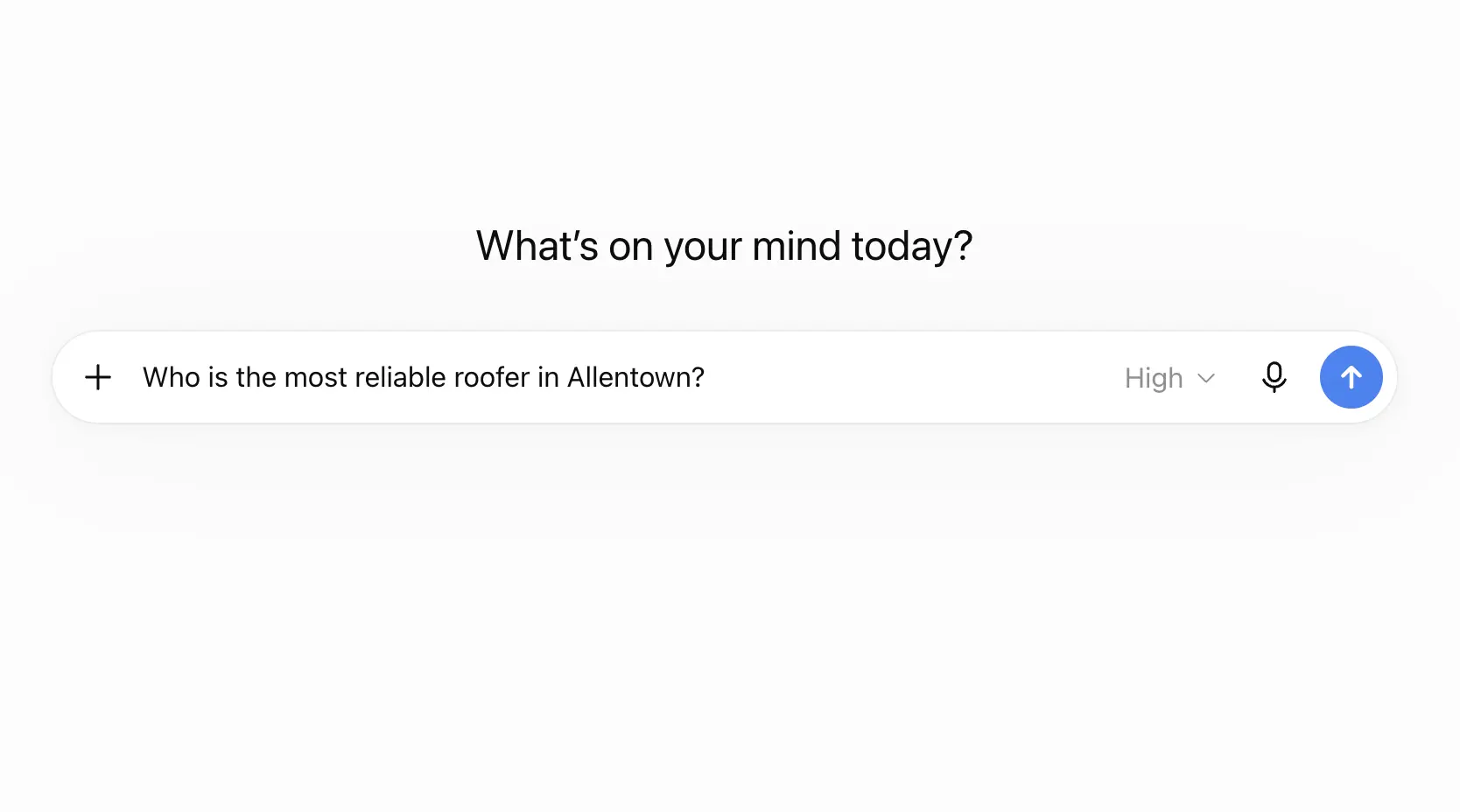
Most advice about getting cited by AI treats “AI” as one thing. It isn’t. ChatGPT, Google’s AI Overviews, Perplexity, and Claude retrieve from four different indexes and reward four different things. A tactic that reliably wins citations in Perplexity can do almost nothing in ChatGPT.
This is the practical version: what each engine actually reads, what the research says moves the needle, and the order we work in when a client asks us to fix their AI visibility.
First: know which engine you’re losing in
Before anything else, spend fifteen minutes establishing a baseline. Write down the ten questions a good customer would actually ask before hiring you — not keywords, questions. “Who’s the best HVAC company in Allentown?” “How much should a roof replacement cost in the Lehigh Valley?” “Is it worth repairing a fifteen-year-old furnace?”
Run all ten through ChatGPT, Google AI Mode, Perplexity, and Gemini. Record which businesses get named, which sources get cited, and whether you appear at all. That spreadsheet is your baseline and your report card, and almost nobody does it before buying an AI visibility service.
I’ve never had a prospect show me a baseline. They’ll show me rankings going back three years and they’ve never once typed their own question into ChatGPT. It takes fifteen minutes and it usually changes the entire conversation.
Bradford Blecker, Founder, Bradford Strategies
How each engine picks its sources
Google AI Overviews and AI Mode
Grounded in Google’s own index, using query fan-out — the system decomposes your question into several sub-questions, retrieves for each, and synthesizes. That matters because you are no longer competing for one query. You are competing for a handful of implied ones you never see.
Ranking well still helps, but far less than it did. Ahrefs’ July 2025 analysis of 1.9 million citations found 76% of cited pages ranked in Google’s top 10. Re-run against a much larger sample in early 2026, that overlap was reported at 38%. Treat the exact figures as directional — methodologies differ between studies — but the direction is consistent across everyone measuring it: Google is increasingly citing pages that don’t rank on page one.
Google-owned properties account for a meaningful share of citations, and YouTube in particular has grown fast as a source. For a service business that films work in the field, that is an unusually accessible opening.
ChatGPT search
Retrieves through Bing, not Google. Measured overlap with Google’s top 10 sits around 6.5% — effectively a different internet. Wikipedia and large reference sources dominate its citation pool, and it cites roughly eight sources per answer.
Two implications that most local businesses miss entirely. First, Bing Webmaster Tools is not optional, and almost nobody has it set up. Verify the site, submit the sitemap, check that Bing has actually indexed your key pages. Second, ChatGPT leans heavily on established third-party sources describing you — which means your presence in directories, industry associations, supplier locators, and local press does more work here than your homepage does.
Perplexity
Roughly 82% overlap with Google’s top 10 and the most generous citer of the group at around 22 sources per answer. Practically, this is the easiest engine to win: if your Google SEO is working, Perplexity largely follows. It is also the best early indicator — if you can’t get cited in Perplexity, your underlying search foundation is the problem, not your AI strategy.
Claude
Retrieves via Brave Search, cites the fewest sources — around six per answer — and skews strongly toward established journalism. It is also notably more willing than ChatGPT to cite content that is a few weeks old rather than same-day. Hardest of the four for a local business to influence directly, and the lowest priority for most service companies.
What the research says actually works
The Princeton-led GEO benchmark tested specific content edits across 10,000 queries and measured the visibility change from each. The three highest-impact edits, in order:
| Edit | Reported visibility gain | What it means for you |
|---|---|---|
| Adding direct quotations | +41% | Quote your techs, your customers, named experts |
| Adding original statistics | +37% | Publish your own numbers — nobody else has them |
| Adding inline source citations | +30% | Cite and link the sources you’re drawing from |
Notice that all three are about credibility signals inside the text. The models are pattern-matching on what a well-sourced, authoritative page looks like. A page that quotes named people and cites its numbers reads as reliable to a machine for the same reason it does to a person.
Format matters too. Structured content — lists, tables, question-shaped headings — is cited at meaningfully higher rates than flowing prose, with one analysis putting listicle-format citation around 25% against 11% for opinion pieces.
The off-site half nobody budgets for
Here is the finding that should reallocate your money.
Ahrefs, analyzing 75,000 brands, found that brand mention frequency correlates with AI Overview presence at roughly three times the strength of backlinks. And when researchers looked specifically at branded queries — someone asking about your company by name — reviews and third-party validation accounted for the large majority of citations, while the brand’s own pages accounted for a small single-digit share.
Which means: when an AI is asked whether your company is any good, it is mostly not reading your website. It is reading your Google reviews, your BBB profile, forum threads, local news, supplier and manufacturer locators, and industry directories.
So the highest-leverage off-site work is unglamorous and specific:
- Get your name, address, and phone identical everywhere. Not similar — identical, character for character. “Suite 110” and “Ste 110” are two different businesses to a machine trying to reconcile records.
- Build review volume and, more importantly, review text. A review that says “replaced our AC in Bethlehem in one day during the July heat wave” is a retrievable fact about your service area, specialty, and responsiveness. A five-star review with no words is not.
- Claim every manufacturer and supplier locator you qualify for. These are high-trust domains that describe you in a structured way, and most contractors are eligible for several they’ve never claimed.
- Get described consistently. If your website says “full-service HVAC,” your Google Business Profile says “air conditioning contractor,” and your Facebook page says “heating and cooling,” you are teaching every model a slightly different fact about what you do.
- Publish video. YouTube’s share of AI Overview citations has grown quickly, and it is a Google property. A tech explaining a common repair on camera is both a citable source and something your competitors mostly won’t do.
People want to buy AI visibility. What they actually need is to go fix their address in eleven places and ask forty customers for a review that says something. It’s not a sexy invoice. It’s the one that works.
Bradford Blecker, Founder, Bradford Strategies
On-site: what to change and what to ignore
Do these:
- Answer the question in the first two sentences of every page. Then earn the rest of the read. A page that buries its answer under four paragraphs of context gives a model nothing clean to lift.
- Make sure it’s server-rendered. If your key content only appears after JavaScript executes, some retrieval systems will never see it. This is the single most common technical blocker we find.
- Use real questions as headings — the ones customers ask, phrased the way they phrase them.
- Publish numbers only you have. Typical job cost ranges in your market. Average response time. Seasonal patterns you see in your own dispatch data. This is the most defensible content a local business can produce.
- Keep structured data accurate. It helps machines parse you correctly. It is hygiene, not strategy.
Ignore these:
- “AI-optimized” schema products. Google has stated there is no separate AI index and no markup that guarantees citation. Anyone selling schema as an AI visibility product is charging strategy rates for hygiene.
- llms.txt. Interesting proposal, not adopted by the major engines. Harmless to add. Do not pay for it.
- Writing for the model instead of the reader. Keyword-stuffed, robotic content performs worse, not better. The systems are trained to recognize quality writing.
- Guaranteed placement offers. Nobody controls what a language model outputs. A guarantee is either a misunderstanding or a lie.
A realistic order of operations
- Weeks 1–2: Build the prompt baseline. Verify Bing Webmaster Tools. Audit name/address/phone consistency across every property you own or appear on.
- Weeks 3–6: Fix server-rendering blockers. Rewrite the top ten pages to answer their question in the opening. Claim every supplier and association listing you qualify for.
- Months 2–4: Publish original data. Build a review-request process that asks customers to describe the actual job. Start filming.
- Months 4–12: Re-run the baseline monthly. Expect movement in Perplexity first, AI Overviews second, ChatGPT last — it is the slowest to reflect changes because it is the furthest from your Google footprint.
Common questions
How long before I see citations?
Technical and formatting fixes can register within weeks. Citation share moves on a six-to-twelve month arc because it depends on off-site signals accumulating. Perplexity responds fastest, ChatGPT slowest.
Do I need to rank on page one to get cited?
Not anymore, and that’s the significant change. Ranking well remains a strong advantage in Google AI Overviews and Perplexity, but a growing share of citations go to pages outside the top 10 — and in ChatGPT, Google rankings are nearly irrelevant since it retrieves through Bing.
Should I block AI crawlers?
For a local service business, no. Blocking them removes you from the answer entirely. That trade-off can make sense for a publisher whose product is the content itself. It does not make sense for a company whose product is a service call.
What if my competitor is cited and I’m not?
Go read what the AI cited. It usually isn’t their homepage — it’s a review profile, a directory entry, a supplier locator, or a news mention. That tells you exactly which off-site surface is doing the work, and it’s almost always one you can also appear on.
Does any of this hurt my regular SEO?
No. Nearly everything on this list — server-rendered content, consistent business data, real reviews, original information, clear structure — is also good conventional SEO. That’s the reassuring part: there is no fork in the road where you have to choose.
The bottom line
Getting cited by AI is not a hack, and it is not a product you can buy in a box. It is four things done consistently: be technically retrievable, answer questions directly, publish information nobody else has, and be described the same way everywhere on the internet.
Want this applied to your market?
We connect blog ideas back to the system: local SEO, Google Business Profile, AI visibility, and conversion-ready sites.