
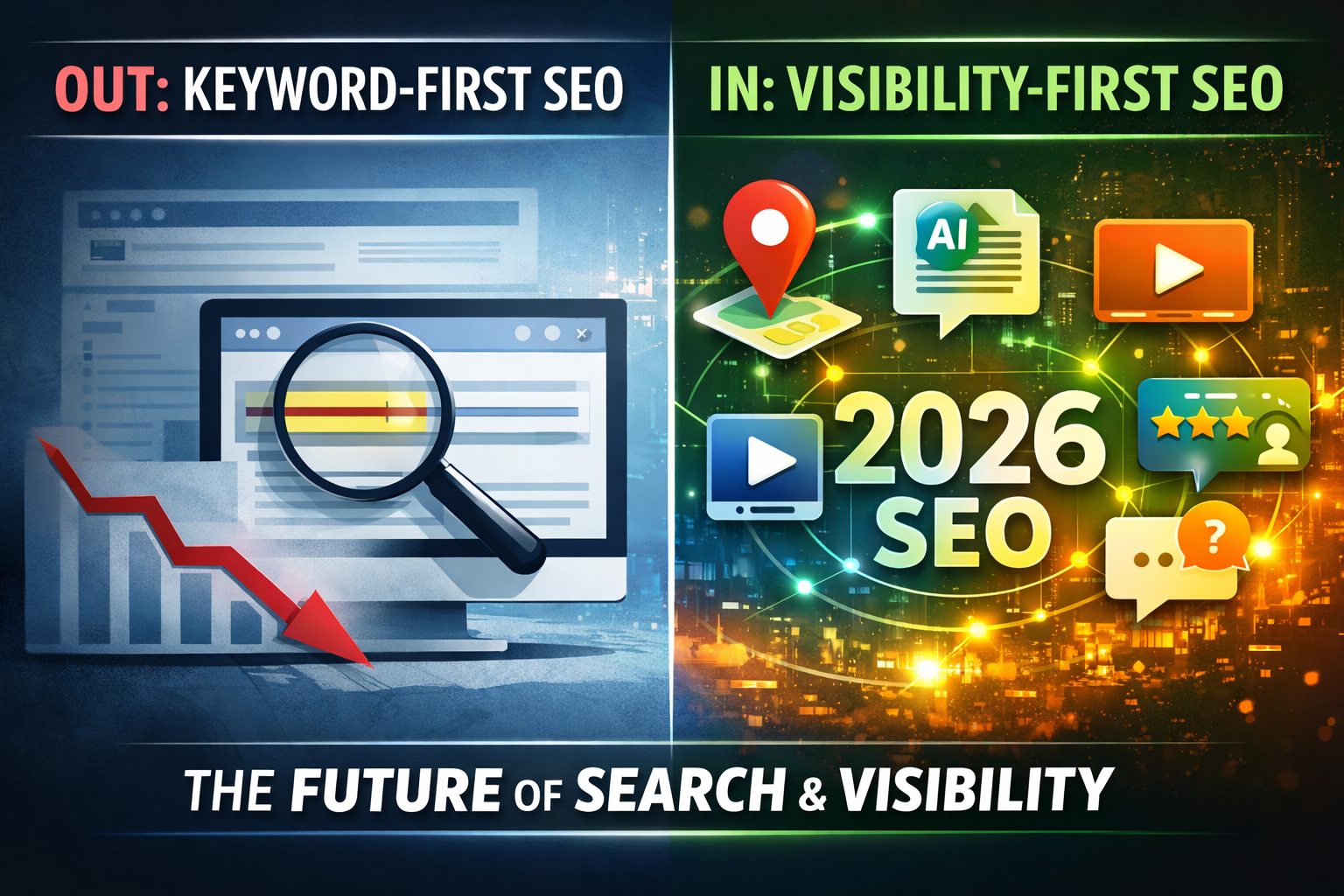
For years, SEO followed a familiar playbook. Pick a keyword, write a page around it, add a few links, and wait for rankings. That approach is not dead, but it is no longer the main driver of visibility. In 2026, SEO is shifting from “keyword-first” to “visibility-first”. That means your business has to be findable across more places, more formats, and more decision moments, not just a single blue link.
If you have ever wondered why a page that is “optimized” still does not win, the answer usually comes down to this. Google and other discovery systems have gotten better at understanding intent, context, and trust. They are measuring quality in a broader way. The winners are the brands that build clear relevance, strong proof, and a consistent digital footprint that makes sense to both search engines and real people.
Bradford Strategies, a digital marketing agency in the Lehigh Valley of Pennsylvania, is on top of this shift. We are actively implementing these changes into how we build SEO strategies for local businesses, contractors, and service brands that need real leads, not vanity rankings.
Why Keyword-First SEO Is Losing Power
Keyword targeting still matters. You still need to use the language your customers use. But the idea that one exact phrase is the key to performance is fading.
Here is what changed.
First, search results are no longer a simple list of ten links. Modern results include map listings, AI summaries, featured snippets, videos, “People also ask,” product panels, local service ads, and more. Your visibility is now spread across a whole results page, and often across multiple platforms.
Second, search engines interpret meaning better than they used to. They can connect related phrases, synonyms, and intent signals. That means the “perfect keyword density” mindset is outdated. A page can rank without repeating a phrase 25 times, and a page can fail even if it repeats the exact keyword perfectly.
Third, user behavior has shifted. People search in longer, more specific ways. They ask questions. They compare options. They want proof. They also discover businesses through Google Maps, YouTube, TikTok, Reddit, Facebook groups, and AI tools. SEO now touches all of that.
The New Model: Visibility-First SEO
Visibility-first SEO is about showing up wherever buying decisions are formed. It focuses on three core outcomes.
1) Being the obvious match for the problem
Modern search systems reward businesses that clearly match intent. That means your site and profiles should answer real questions and show real expertise.
Instead of one page for one keyword, you build coverage. You create clusters of content that support the main service pages. You add helpful FAQs. You explain your process. You show examples. You talk like a human, not a robot.
2) Building trust signals that stack up
Trust is not one thing. It is a pattern.
Search engines look at reviews, brand mentions, local citations, backlinks, on-site clarity, and user engagement. Prospects look at photos, past work, pricing expectations, response time, and whether you seem like a real business they can call today.
In 2026, trust is a ranking factor and a conversion factor. If you only do “SEO on the site” but your Google Business Profile is thin, your reviews are stale, or your business info is inconsistent across platforms, you are leaving money on the table.
3) Winning multiple surfaces, not one position
Ranking number one for a single keyword is less valuable than it used to be, because people might click the map pack, skim an AI summary, call from a listing, or watch a short video.
The new goal is surface area. You want to show up in the map pack, in organic listings, and in question-based results. You want your brand to appear when people compare options. You want your content to be used as a source in AI-driven answers.
How Visibility Really Works Now
If you want a simple way to understand modern visibility, think of it like this.
Search engines and AI systems are constantly asking: “Is this business the best answer for this person right now?”
To decide, they weigh signals that come from four places.
On-site signals
This is the foundation. Your site should have clear service pages, location relevance, fast performance, and clean structure. It should also communicate what you do in plain language. If a human cannot figure it out quickly, search engines will struggle too.
Off-site signals
These include backlinks, local citations, and brand mentions. In 2026, it is not just about getting a random link. It is about getting the right types of mentions from relevant places. Local chambers, associations, suppliers, niche directories, and local press can move the needle.
Entity and identity signals
Search engines model businesses as entities. That means consistency matters. Your name, address, phone, service categories, service areas, photos, and business details should align across Google, Apple, Bing, Facebook, and industry directories.
When those details conflict, visibility gets harder.
Behavioral signals
Search systems learn from what users do. Do they click, stay, and convert, or do they bounce and search again? Do they call from your listing? Do they request directions? Do they read your content and keep moving deeper?
This is why modern SEO is tightly connected to web design, messaging, and offer clarity. Traffic is not the finish line. Action is.
What This Means for Local Businesses in 2026
For a contractor, home service company, or local provider in the Lehigh Valley, this shift is a big deal. Your prospects are not just typing “roofing contractor Bethlehem PA” anymore. They are asking:
“How much does a metal roof cost in PA?”
“Best time of year to replace windows in Allentown”
“Who installs mini splits near me?”
“What is the difference between cabinet painting and refacing?”
If your brand has helpful answers, strong reviews, real project photos, and a clean digital foundation, you win more often. If you only have a basic website and a half-finished Google Business Profile, you get squeezed out by businesses that look more complete.
How Bradford Strategies Is Implementing This Shift
Bradford Strategies is a digital marketing agency in the Lehigh Valley of Pennsylvania, and we are building SEO strategies around how visibility works now, not how it worked five years ago.
Here is what that looks like in practical terms.
SEO that is built around real topics, not just phrases
We develop service and supporting content that covers the questions people actually ask before they buy. That includes core service pages, supporting blog content, and FAQs that match local intent.
Stronger Google Business Profile strategy
In local markets, your Google Business Profile is often your best lead source. We treat it like a living asset, not a set-it-and-forget-it listing. That includes category strategy, services, photos, posts, Q&A support, and review growth.
Digital infrastructure that supports trust
We tighten the basics that many businesses skip. Consistent business information across platforms. Clean technical SEO. Fast pages. Clear calls to action. Location relevance that makes sense. This makes it easier for search engines and customers to trust what they see.
Content that supports both search and AI discovery
As AI-driven discovery grows, content needs to be structured, clear, and useful. We focus on direct answers, strong page structure, and real proof. That helps with classic SEO, and it also helps your brand show up in AI-assisted search experiences.
The Bottom Line
Keyword-first SEO is no longer the whole game. In 2026, visibility comes from being the clearest, most trusted option across multiple surfaces.
If you want to win, build relevance through topic coverage, build trust through consistency and proof, and build presence beyond a single page ranking.
If you want help adapting to this shift, Bradford Strategies is already there. We are building SEO strategies that reflect how people search now and how platforms decide who gets shown. And we are doing it with a practical goal in mind: more calls, more leads, and a stronger local brand presence across the Lehigh Valley. Contact Us today for a free SEO audit.