
Somewhere along the way, “doing marketing” got reduced to “posting on social media.”
You hear it all the time:
“We need to be more active on Instagram.”
“We should start posting more.”
“We need to grow our following.”
And then months go by. Content gets posted. Maybe a few likes roll in. A comment here and there. But the phone doesn’t ring more. The leads don’t meaningfully increase. Revenue doesn’t change.
And just to clarify – social media refers to the popular platforms like Facebook and Instagram. That’s all. So the term or idea of ‘social media marketing’ only encompasses those social platforms. This does not include Google Business Profiles, Google Ads, SEO – we hear this a lot – somewhere at some point in time ‘social media marketing’ became the understood catch all term for marketing for small businesses and its quite different. Not the fault of the business owner – things have gotten confusing over the years – we get it.
So what’s the problem?
It’s not that social media doesn’t work. It’s that social media was never meant to carry the weight of your entire marketing strategy.
It’s one piece of a much bigger system. And when you treat it like the system itself, everything starts to feel disconnected, inconsistent, and frustrating.
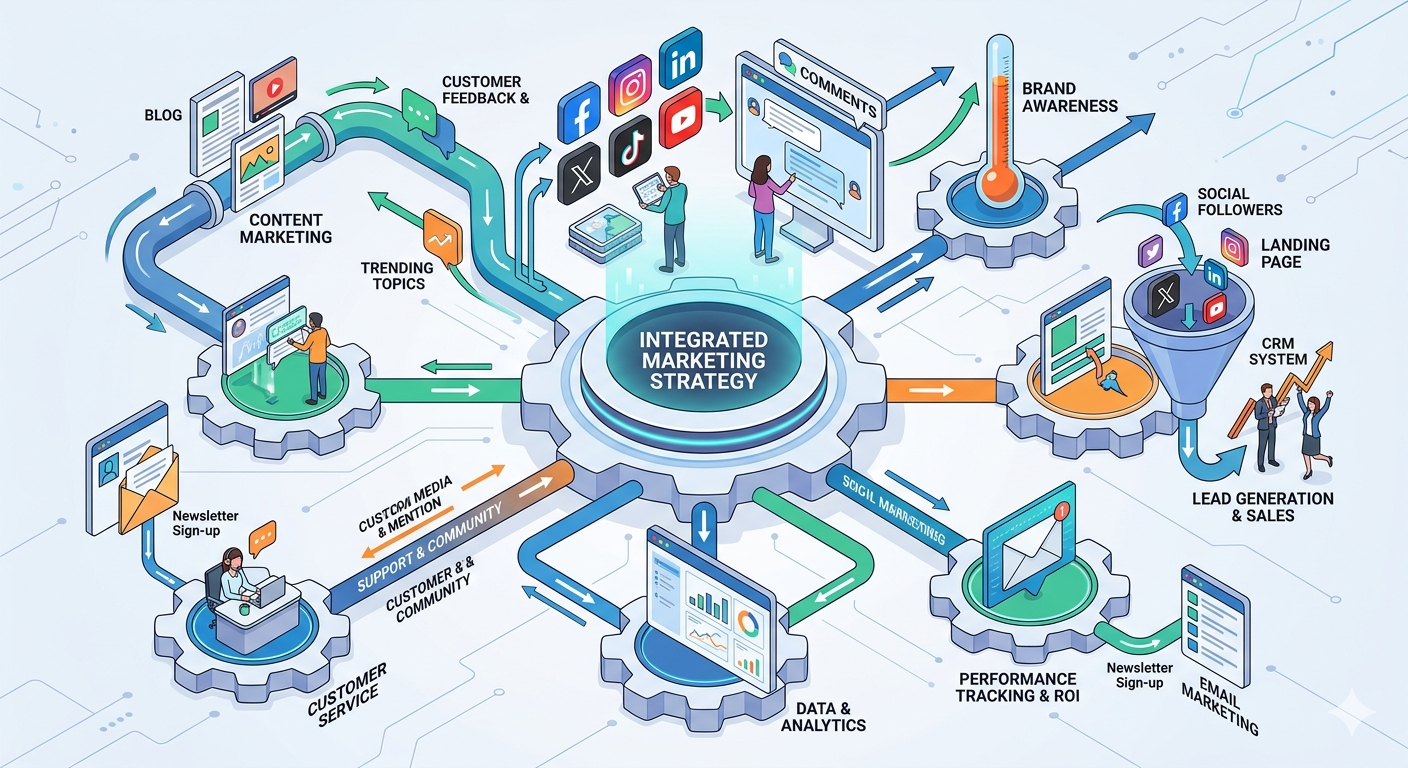
Marketing Isn’t One Thing. It’s a System.
Digital marketing, when it’s actually working, is a system designed to do three things:
- Get attention
- Build trust
- Turn that into revenue
That’s it.
But those three things don’t happen in one place. They happen across multiple channels that all play different roles. When those roles are clear and connected, things start to click. When they’re not, you get what most businesses experience, which is a lot of activity with very little return.
Where Social Media Actually Fits
Social media is a visibility tool. It keeps your business in front of people. It shows personality. It gives you a place to share what you’re doing, what you’ve done, and what you know.
It’s a way to stay present.
What it’s not is a reliable way to capture high-intent customers. Most people are not opening Instagram or Facebook because they urgently need a roofer, a contractor, or a service provider. They’re scrolling. Killing time. Catching up.
That matters.
Because when someone actually needs a service, they don’t scroll. They search.
The Real Engine: Search
When someone types “bathroom remodeler near me” or “emergency HVAC repair,” that’s not passive interest. That’s intent. That’s someone actively looking to hire. If your business shows up there, you’re in the game. If it doesn’t, no amount of posting is going to make up for it.
Search is where demand already exists. You’re not trying to convince someone they might need you. They already know they do.
This is why businesses that dominate locally almost always have strong visibility on Google, especially through their website and their Google Business Profile. They’re showing up at the exact moment someone is ready to make a decision.
The Website: Where Decisions Actually Happen
Every marketing effort eventually leads back to your website.
This is where people decide if they trust you. If you’re legitimate. If you’re the right fit. If your site is confusing, thin, outdated, or generic, it doesn’t matter how they got there. You lose them.
A good website doesn’t just look decent. It answers questions. It shows real work. It clearly explains services. It makes it easy to take the next step.
Most businesses don’t have a traffic problem. They have a conversion problem.
Content: The Backbone Nobody Sees
Content is what fuels everything.
It’s the service pages that help you rank. It’s the articles that answer real questions. It’s the photos and videos that prove you actually do the work.
It feeds search. It gives social media something to post. It supports ads. It builds authority over time.
Without content, everything else feels empty.
Paid Ads: Speed, Not Strategy
Paid ads can work. They can bring traffic quickly. They can fill gaps.
But they are not a foundation. They are an accelerator.
If the underlying system isn’t strong, ads just pour more people into a broken process. And when the budget stops, so does the traffic.
Reviews: The Silent Closer
People don’t just look at your business. They look at what other people say about your business.
Reviews are often the deciding factor. Not your logo. Not your posts. Not even your pricing.
If two companies look similar, the one with better reviews wins almost every time.
Trust is built before you ever speak to the customer.
The Channels Only Work When They Work Together
This is where most businesses get it wrong.
They pick one channel and expect it to do everything.
They post on social media and expect leads.
They run ads without fixing their website.
They build a website but ignore search (SEO)
Then they wonder why nothing feels consistent.
A real system connects everything.
Search brings in people who are already looking.
Your website turns them into leads.
Your reviews reinforce trust.
Your content strengthens your visibility.
Your email and follow-up increase lifetime value.
Your social media keeps your brand in front of people over time.
Each piece supports the others.
None of them replace each other.
Why So Many Businesses Feel Stuck
There’s a growing disconnect right now.
Tools are easier than ever. Content is easier than ever. AI can generate posts, captions, blogs, videos.
And yet, a lot of business owners feel more confused than ever.
Because they’re focusing on the pieces instead of the system.
They’re asking:
“What should I post?”
“How often should I post?”
“What platform should I be on?”
Instead of asking:
“Where do my customers actually come from?”
“What happens when they find me?”
“Why aren’t they converting?”
A Straight Answer Most People Won’t Say
Brad from Bradford Strategies put it pretty bluntly:
“More and more business owners look busy online, but when you dig in, they’re completely clueless about how their marketing actually works. They’re posting, boosting, trying things, but there’s no system behind it. It’s just noise.”
That’s the reality.
It’s not a lack of effort. It’s a lack of structure.
What Actually Works
The businesses that grow consistently aren’t guessing.
They build around intent first. They show up where people are searching. They make sure their website can convert. They build trust through real proof. They use content to support everything. And then they use social media to stay visible, not to carry the business.
That’s the difference.
The Bottom Line
Social media isn’t useless. It’s just misunderstood.
It’s not the engine. It’s not the strategy. It’s not the thing that drives consistent growth on its own.
It’s one piece of a system that, when built correctly, works together to bring in leads, build trust, and grow a business.
If your marketing feels scattered, inconsistent, or frustrating, it’s probably not because you’re not doing enough.
It’s because the pieces aren’t connected.
And until they are, no amount of posting is going to fix it.